Types of retail shrink: 7 common loss patterns in retail today
Retail shrink goes far beyond shoplifting. See the 7 common loss patterns, how they happen, and what retailers can do to tackle them.
Written by
Everseen
Read time
10 min
Published on
Nov 27, 2026

Shrink is an unavoidable part of the retail business, with contributors ranging from shoplifters and inventory errors to spoilage, pricing errors, and even internal theft. These all add up to $112 billion in annual losses for retailers.
Addressing the problem starts with understanding the different sources, how they manifest, and the specific environments that let them thrive. Here are the different types of shink in the retail environment and how they manifest.
1. Shoplifting and organized retail crime (external theft)
Shoplifting and organized retail crime (ORC) are among the most visible forms of retail shrink, accounting for up to 36% of all retail shrink, according to the NRF.
While both shoplifting and organized retail crime fall under external theft, they operate at different scales. Shoplifting occurs when customers intentionally take merchandise from a store without paying. This can happen through concealment, mis-scans, product-switching, or any other number of methods that bypass the checkout process.
Organized retail crime is shoplifting done by an organized group for profit. These groups target high-value or high-volume merchandise and use online marketplaces, pawnshops, and other resale channels to turn stolen goods into profit.
ORCs can be hard for retailers to combat because they can involve multiple people, locations, and transactions rather than a single shrink event. Some stores also have a non-confrontation policy with shoplifters.
See how retailers use shoplifting prevention devices to tackle external theft.
2. Employee shrink
Employee shrink, or internal shrink, refers to losses that occur when employees take merchandise, cash, or other store property. This is the second-largest contributor to shrink, accounting for 29% of annual retail shrink.
Internal shrink comes in many forms. For example, employees may take products directly, give unauthorized discounts to friends or customers (a practice referred to as sweethearting), manipulate refunds, remove cash from registers, or collaborate with shiplifters or ORC groups.
Because employees already have access to the store’s stockroom, registers, and transaction areas, internal shrink can be harder to detect than external. See the other differences between internal and external theft here.
3. Administrative errors
Not all shrinkage happens because somebody took something. In 21% of all instances, shrinkage results from administrative mistakes or inaccuracies in retail processes.
A few common administrative errors include:
- Receiving and recording errors
- Pricing and markdown errors
- Unrecorded goods or spoilage
- EPOS, return, and transfer errors
As with employee shrink, loss from administrative errors can be difficult to identify because there are no obvious clues to investigate. Teams might only notice the problem when high-value items go missing, and even then, they may first suspect external causes like shoplifting before considering administrative mistakes.
4. Vendor fraud
Retail shrink can also result from errors and misrepresentation on the part of vendors and suppliers. They may intentionally or unintentionally set incorrect prices, deliver the wrong quantities or types of products, or falsify delivery documentation, resulting in loss for the retailer.
Some of the most common examples of vendor fraud include:
- Short-shipping: Delivering fewer units than ordered and invoiced.
- Phantom deliveries: Billing for an order that never arrives.
- Overcharging: Billing above the agreed contract price.
- Product substitution: Delivering counterfeit or lower-grade goods in place of what was ordered.
- Invoice and document manipulation: Falsifying invoices, delivery receipts, or credit notes to conceal discrepancies.
According to a 2017 ECR Retail Loss Study, retailers attribute an estimated 12% of shrink, or €1.6 billion annually, to intercompany fraud. The NRF estimates that vendor fraud accounts for over 5% of all retail shrink.
In medium to large-scale operations, vendor fraud is harder to identify because retailers are tracking so many suppliers, transactions, SKUs, and deliveries at once. Discrepancies can easily go unnoticed unless the retailer has effective processes for verifying deliveries, reconciling invoices, and auditing supplier transactions.
5. Damaged, spoiled, or expired goods
The USDA Economic Research Service estimates an average loss of 11.6% across 31 vegetable types due to spoilage and other factors. Unfortunately, this type of shrink is a constant in many environments, and retailers often build an expected level of loss into their budgets, pricing, and margin targets.
Loss prevention protocols can reduce these losses, but they can't eliminate them entirely. Product damage, workplace accidents, slow-moving inventory, accidental contamination, wastage, and poor storage conditions will always account for some level of loss.
6. Fraudulent returns
Product returns are an important part of building customer trust, but they can also expose retailers to loss. Return fraud occurs when someone manipulates a retailer’s return policy to obtain money, merchandise, or store credit they aren’t entitled to. The NRF estimates that 9% of all retail returns are fraudulent.
7. Digital and e-commerce fraud
As retailers have expanded online, loss has followed. These losses don't always fit the traditional definition of shrink, and many retailers track them separately, but they still erode revenue and margin. Common schemes include account takeover, fraudulent orders, and the abuse of promotions and loyalty programs.
Digital fraud can also overlap with internal shrinkage, where employees and customers collude to exploit promotions, manipulate transactions, or process fraudulent returns.
How to reduce shrink today
Shrink is a constant across the retail landscape, but shrink rates and the types that manifest vary between different store formats.
Retailers often use a combination of technology solutions, traditional loss prevention strategies, and organizational restructuring to combat shrink. Here are some of their most effective strategies:
- Storewide visibility through CCTV and better product placements to improve visibility and deter theft
- Better employee screening, access controls, and inventory audits to mitigate internal shrink
- Exception-based reporting to flag odd transaction patterns like high void rates, unusual refunds, and discounts.
- RFID and EAS tracking for high SKU items and products
We’ve covered how to tackle retail shink in different verticals, and that will serve as a more comprehensive guide.
From aisle to checkout: Tackling shrink across the whole store
Everseen’s Vision AI helps retailers tackle shrink wherever it happens, from the self-checkout, where many loss prevention efforts today are concentrated, to the shop floor, where loss is harder to track.
Our platform treats shrink as a recoverable loss, not just another line in the P&L. In an industry with razor-thin margins, even small reductions make a real difference to profitability, and our platform is built to recover as much as possible across the whole store.
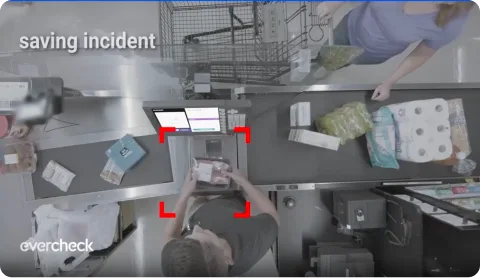
At checkout, Checkout Intelligence detects over 30 loss patterns, including product switching and scan avoidance. When loss is detected, a simple on-screen nudge prompts the shopper to rescan an item, and, in over 80% of cases, this is enough to recover the loss.
On the shop floor, Store Intelligence extends visibility to the shelves and aisles, flagging loss-related behavior before it reaches checkout.
Data Intelligence brings it together, giving your teams a view of the loss patterns identified and stopped, how much is being recovered, and events across the store and wider estate.
Everseen is trusted by 11 of the world’s 20 biggest grocery retailers, and our platform recovers $500 million annually for retail partners.
Contact our team to see how Everseen can help your estate tackle shrink comprehensively.
Subscribe to the blog
Subscribe to Everseen's blog to receive emails about new posts and resources.