Shoplifting prevention devices: What works & what’s missing
Which shoplifting prevention devices work best? Compare how EAS tags, CCTV, locked cases, and turnstiles perform, plus their costs and trade-offs.
Written by
Everseen
Read time
10 min
Published on
Oct 7, 2026

The retail loss prevention line-up has remained relatively consistent, even as self-checkout has become more prevalent. The classic loss prevention technologies like door alarms linked to RFID tags or EAS labels, locked cases for high-value items, and surveillance cameras remain standard in most retail stores.
Individually, these tools can stop shoplifting in the moment, but they often miss out on important context. More crucially, they can’t help retailers connect loss events across time or locations. So when the same theft patterns repeat across stores, teams are stuck tackling each incident individually, when one targeted fix could plug the leak for good.
In 2022, US retail shrink rose to 1.6% of sales, up from 1.4% the year before, adding up to $112.1 billion in losses across the industry. Shoplifting is a major contributor, and because it takes so many forms, no single tool can stop it alone. That's why retailers have come to rely on a mix of the following.
What are the common types of shoplifting prevention devices?
Electronic article surveillance (EAS) tags
The hard tags and adhesive labels on apparel, electronics, and increasingly, grocery items remain the industry default. A study spanning three decades of case studies found EAS can reduce shoplifting and overall inventory shortage by roughly 35 to 75%, depending on tag type, product category, and how consistently a store enforces deactivation at the till.
In terms of effective loss prevention, that is a genuine result. But it is a deterrent measure, not a detection one; tags can still be defeated by removal, foil-lined bags, or a missed deactivation that later trips an alarm on an innocent customer.
RFID-based inventory tracking
RFID is often grouped with EAS, and while both help retailers tackle shrink, they serve different jobs. While EAS tags trigger an alarm at the door, RFID tags let teams track individual items through the store. With it, retailers can build a live view of where inventory is and how it moves.
The limitations with RFIDs are largely cost and infrastructure-related. Individual items need to be tagged before they can be tracked, and readers need to be installed across the store to pick them up. This puts a practical ceiling on how widely retailers can deploy it. And unlike EAS, RFID tags can’t stop theft. It can only inform retailers that a tagged item is missing.
CCTV and security cameras
Cameras are close to universal across retail. But their effect on loss largely depends entirely on whether anyone is watching. A 40-year meta-analysis of CCTV studies found that cameras cut crime by around 13% overall, but the effect came from actively monitored systems. So while there is the deterrence factor, unmonitored footage can’t actively help retailers stop shoplifting.
This puts CCTV closer to an investigation or evidence tool rather than a real-time prevention device.
Visible staff and security personnel
Physical presence remains one of the most widely used deterrents for shoplifting and is favored by both large-format retailers and smaller outfits. Security guards were rated as a deterrent by 80% of respondents, many of whom said they'd abandoned a product they had taken with intent to steal due to security presence.
Unfortunately, the deterrent effect of security isn’t universal. The same research found that in other cases, guards are viewed by prospective thieves as an "easily managed inconvenience," instead of a genuine risk. And even when a guard does spot a theft in progress, they don't always have the power or authority to apprehend shoplifters.
Casing & benefit denial devices
Locked cases, spider wraps, and ink tags can limit access or make theft less appealing to shoplifters. Spoiled items are harder to resell and have less appeal to thieves, and ink tags in particular have been shown to reduce theft by 42%.
However, these have their own shortcomings. They can only protect a limited number of devices (locked cases can only contain so many items), and the hardware and staff needed to run them add up. They also add significant friction to the checkout flow, since customers have to wait for a staff member to unlock a case or remove a tag.
Signage and mirrors
Adding passive elements such as warning signage and well-placed mirrors can be a useful deterrent. However, warning is the best result they offer; they’re not preventative in the same way that cameras or security staff might be, and they’re not able to track or monitor items like EAS tags.
Self-checkout monitoring
For many retailers, self-checkout accounts for a significant share of shrink. Roughly 4% of SCO transactions involve a loss event, and for a large retailer running dozens of lanes across multiple stores, those losses will multiply quickly.
Most self-checkout loss prevention is a staff member monitoring several lanes at once, often busy helping customers with scale or scanning errors. This alone means reduced oversight for opportunistic shoplifters who can switch barcodes, skip scanning an item, or walkaway altogether.
Turnstiles / one-way exit gates
Turnstiles and one-way gates are a simple but effective way to tackle shoplifting and have been previously introduced with self-checkout by large retailers, including Sainsbury's, Morrisons, Aldi, and Primark in the UK. The mechanism is simple: gates enforce one-way traffic so customers who don’t complete a purchase have to be let through by staff, reducing the chances that shoplifters can leave without paying.
The trade-off here is customer experience, as some shoppers have described feeling "held hostage" while waiting for staff to let them through. The customer friction can pile on further when staff are busy helping other shoppers or covering several check-out lanes at once.
Why shoplifting prevention devices fail to address the problem
While every device above has its place, most of them do one job, often after the fact or as a blunt deterrent.
They don’t always communicate, and, in some cases, they need human oversight to be truly effective. For example, a security tag doesn't know what the camera saw. The camera doesn't know what the till rang up. And the security guard watching the screens is unlikely to catch a product concealed in the aisles.
There's a second, bigger problem: these devices are built to stop shoplifting, and shoplifting is only part of the loss picture. At self-checkout especially, a lot of loss comes from genuine mistakes: a missed scan, the wrong produce code, or a shopper confused by the screen.
In fact, over half of all self-checkout loss is accidental. A locked case or an ink tag does nothing to stop an honest customer who simply forgot to scan an item.
Retailers need more sophisticated technology to close these gaps. The solution needs to see what's happening as it happens, connect what happens at the shelf with what happens at the till, and respond the right way to both theft and honest mistakes.
How Everseen prevents shoplifting and loss
With cameras across the store and self-checkout monitors installed, reducing retail loss is now a case of unifying the technology. Everseen’s Retail Vision AI does exactly that, connecting with existing infrastructure like security cameras and POS networks to connect the dots.
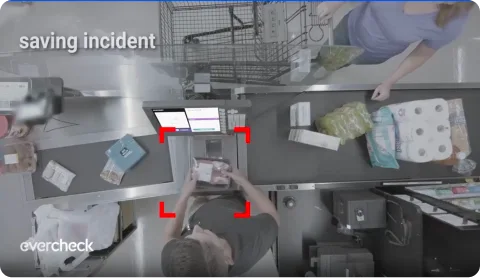
At checkout, Everseen identifies over 30 loss patterns, including non-scans, items left in baskets, product switching, and abandoned transactions. Then, it resolves most of them with a Soft Nudge on screen that lets the shopper self-correct without confrontation or accusation.
Over 80% of non-scan events are cleared this way. Even where deterrence is the only effect, such as the system simply being present, loss events drop by 25%.
In high-risk aisles, Everseen recognizes behaviors such as concealment and repeated handling of high-value products. When identified, shoppers are notified that the area is being monitored, providing instant deterrence.
Data from across the store is also fed into a store-wide intelligence layer, giving retailers a clear view of what’s happening in real time. That means retailers can see how many instances of suspicious behavior occurred in the aisles, how much loss was stopped at checkout, and so much more. So instead of simply preventing shoplifting and loss in the moment, retailers can spot the underlying patterns and address them at the source.
Read more: How AI detects theft and shoplifting
Your loss prevention strategy should go beyond shoplifting
The most effective shoplifting prevention devices on the market today still have a role, but they only solve part of the problem.
Shoplifting is a part of a larger loss problem that Everseen helps retailers solve. Independent research from Forrester found that retailers using Everseen see 374% ROI over three years, and it adds an average of $88,000 to a store's bottom line annually.
If you're rethinking how your stores catch loss in real time, not just after the fact, get in touch with the Everseen team.
Subscribe to the blog
Subscribe to Everseen's blog to receive emails about new posts and resources.
.jpg)