How retail AI detects theft and shoplifting
Read about the different types of retail theft, how Retail AI tackles them, and why it’s better than traditional loss prevention methods.
Written by
Everseen
Read time
10 min
Published on
Sep 22, 2026
Retail shrink accounted for $112.1 billion in losses in 2022, up from $93.9 billion in 2021, and now makes up 1.6% of total retail sales. This covers the full range of loss in a retail environment, from deliberate shoplifting and organized theft to accidental scan errors.
Traditional approaches to reduce shrink and address theft, like CCTV, manual surveillance, and EAS tags, are effective, but they have their gaps. They don’t always catch all instances, and teams can’t reasonably surveil the entire shop floor 24/7.
That's why retailers are implementing Vision AI – the technology behind retail AI solutions. Its speed and accuracy make it highly effective at stopping loss in real time, catching what traditional systems miss. Last year, Everseen's Vision AI solution helped retailers generate over $500 million in extra sales from recoveries at checkout.
This guide will take a close look at what’s possible with retail AI theft prevention, how it tackles other forms of loss, and how it compares to traditional loss prevention methods.
What are the most common types of theft and loss in retail
Retail loss occurs in many forms, and not all of it is deliberate. External theft instances like shoplifting make up 36% of total shrink, the largest of all categories identified by the NRF. But there are other forms as well, including customer confusion and errors at checkout, process errors, and even failures in the administrative chain.
Theft and shoplifting, specifically, are often driven by a variety of factors and can show up in the store, at checkout, among the staff, and in the supply chain of a retail business.
Here are some of the most prevalent occurrences:
- Opportunistic shoplifting: Usually quick, unplanned theft by people who conceal or walk out with unpaid products.
- Organized retail crime (ORC): Coordinated groups targeting goods in planned operations.
- Self-checkout theft: Theft caused by missed scans, barcode switching, or intentional under-scanning at checkout.
- Employee theft (internal shrink): Employee-driven loss through fraud, sweethearting, refunds, or inventory theft.
How retail AI theft detection works
Retail AI theft detection is powered by Vision AI, and it works by continuously monitoring retail environments for patterns of behavior, inventory movement, and transaction irregularities that point to shrinkage.
Rather than depending on isolated CCTV footage, unrealistic monitoring expectations, or manual audits, retail AI systems use Computer Vision to give your team real-time coverage of what's happening across the store floor.
The cameras capturing the footage are, in most cases, already installed in-store as part of the larger loss prevention strategy. Retail AI can seamlessly integrate with this existing camera network so there’s no hardware rip-and-replace required.
All activity captured by your in-store cameras is analyzed anonymously against known loss patterns, and when something needs attention, the right team member gets an alert immediately.
With cutting-edge retail AI providers like Everseen, the footage is processed at the edge instead of being sent to the cloud first. This makes real-time intervention possible: a missed scan at self-checkout can trigger a prompt on the customer's screen within milliseconds before they complete payment.
Where staff intervention is necessary, teams will get notified immediately, removing the chance for loss patterns to go unaddressed.
Here are some of the ways AI theft detection works in retail environments:
AI-powered POS and checkout monitoring
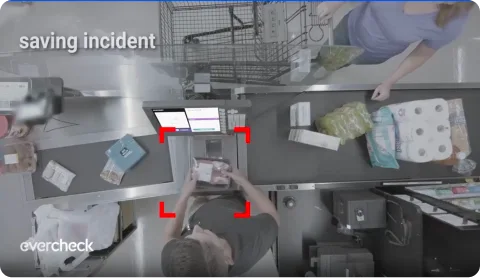
Computer Vision works by continuously analyzing video footage of customer and staff interactions at the point of sale, flagging suspicious behavior based on its training data.
Everseen’s system, specifically, is trained to look for over 30 unique fraud and loss patterns, including the following:
- Non-scans and skip scans
- Label swapping or product switching
- Unchecked items at the bottom of the basket or cart
- Sweethearting and cashier fraud
So, if a shopper switches an item with one of lower value, for example, the system detects this and displays a Soft Nudge on screen, prompting the shopper to address the mistake.
In 80% of cases, scan incidents like these are addressed by Everseen’s system without requiring staff intervention.
Behavioral analysis at the shelf
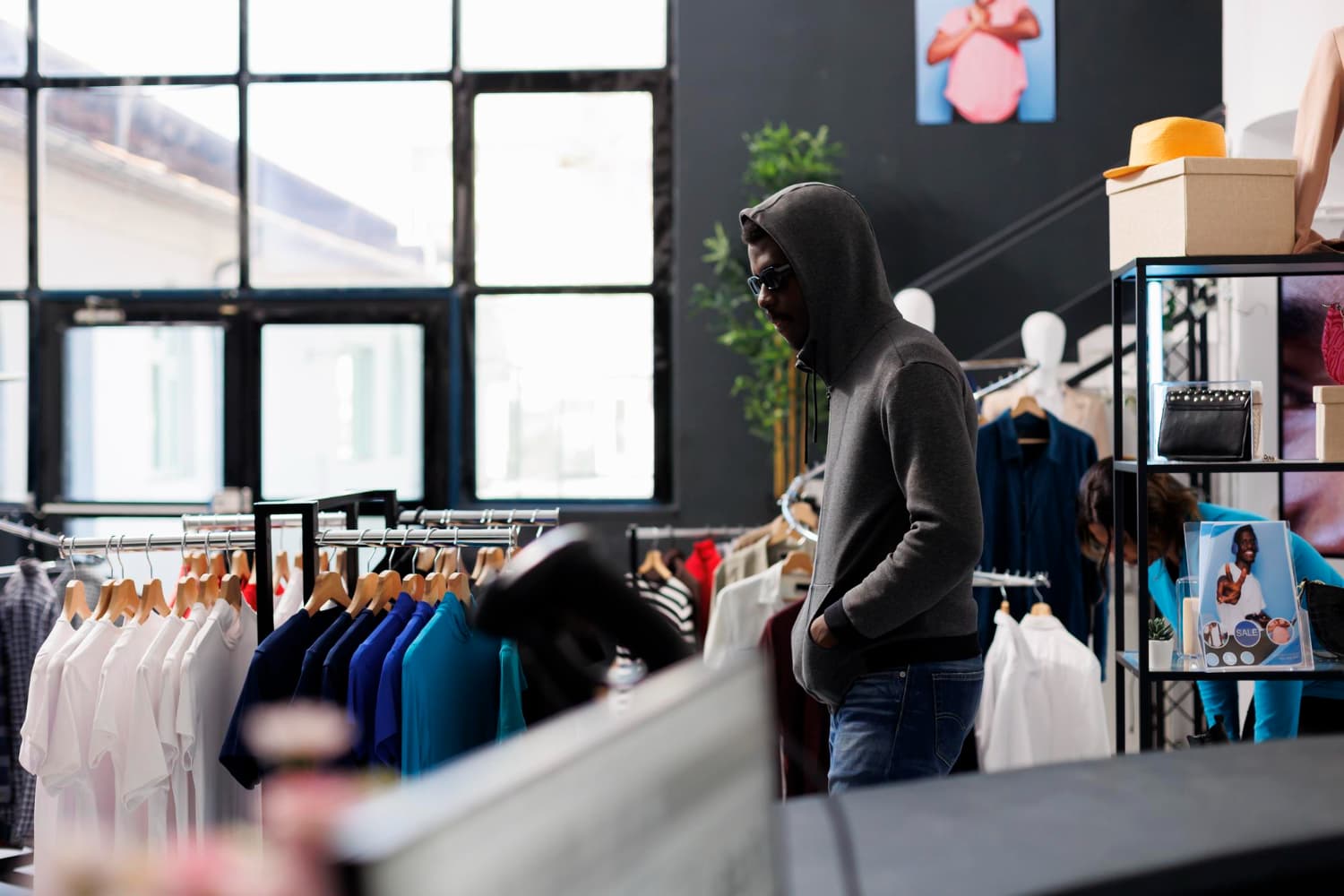
Building on Computer Vision, behavioral analysis uses real-time video to identify suspicious patterns based on how shoppers handle products. It picks up on signals consistent with loss, like concealing items in clothes.
Your team doesn't need to watch for any of this manually. The system scans continuously in the background and plays an audio message notifying the shopper that the area is monitored. Staff receive alerts when intervention is genuinely needed, and that way, they can focus their energy where it matters most.
Employee fraud and internal risk detection
Internal shrink or employee fraud is a major liability for retailers globally. According to NRF, 28% of all retail shrink is internal theft, and that covers employees, contractors, and other personnel with authorized access to business processes.
AI can reduce employee theft at checkout by searching for activity that is consistent with theft and loss. Some of the internal theft patterns retail AI scans include:
- Sweethearting: Detects instances of employee sweethearting and other scan avoidance patterns at staffed lanes
- Scan avoidance: Identifies deliberate manipulation of the scanning process by staff
In both cases, patterns are flagged immediately, giving your team the information they need to act while the transaction is still fresh, rather than waiting for it to surface in exception reporting days later.
How Everseen tackles the full spectrum of retail loss
Everseen's platform is built to address the full spectrum of retail loss, not just deliberate theft. Accidental non-scans, checkout errors, and aisle-level loss all feed into that 1.6% shrink figure, and the platform can flag them in real time. Across its retail partners, Everseen recovers $500 million in revenue annually.
For decades, retailers have relied on tools like CCTV cameras, security guards, receipt checks, and manual audits to reduce shrink. These methods still have a role to play, but they struggle to keep up with the scale, pace, and complexity of modern retail loss.
Here's how retail AI compares to traditional approaches of theft and loss prevention.
Retail AI is the future of theft detection
With shrink costing $112 billion in losses annually, retailers need a solution that can reliably prevent loss or tackle it as it occurs. Everseen’s Vision AI solution can give your teams the needed tools to tackle loss at the source.
Contact our team to see how Everseen fits into your retail operations.
Subscribe to the blog
Subscribe to Everseen's blog to receive emails about new posts and resources.



.jpg)