Smart friction in retail: Reducing friction without compromising loss prevention
Friction never disappears from retail, but it can create opportunities. See how smart friction helps retailers at checkout and in store.
Written by
Everseen
Read time
10 min
Published on
Oct 30, 2026

Smart friction is traditionally understood as deliberately introducing friction points at the moments they matter most. This could be a lock case around a high-value product or pauses at self-checkout when something looks off.
But at Everseen, we see smart friction as an opportunity to smoothen out already-existing friction points that shoppers experience, without creating new ones.
Friction is a part of the in-store experience
Friction points are already abundant in the modern retail environment. A prime example is at self-checkout, where missed scans can hold up the queue until attendants walk up to help customers rescan. Part of the reason this happens is that shoppers are handed a process nobody ever showed them how to use. As Everseen CEO Joe White told Retail Week, "It's not like you or I as consumers were ever trained on how to properly check out.”
In most cases, he adds, a missed scan is unintentional. It’s typically due to innocent errors like obscured barcodes, crumpled labels, or an item the shopper thinks scanned but didn’t.
Friction points like these are common and, in many instances, built into how loss prevention works at self-checkout. There are other friction points throughout the store as well:
- Waiting for attendants to come open lock cases because of prevention
- Finding stockouts on the shelves
Retailers don’t have to introduce these and, in many instances, even work to smoothen out the shopper experience. The tradeoff, unfortunately, becomes switching one problem for another.
Lock cases introduce friction while trying to minimize loss. SCO aims to smoothen customer checkout and improve efficiency, but misscans can create frustrating customer experiences.
The question for retailers then becomes, how do we reduce friction without compromising on efficiency or loss prevention?
The answer is smart friction, and computer vision AI is how retailers make that possible.
Computer vision AI creates opportunities from shopper friction
Smart friction is more than just introducing deliberate process slowdowns. As Joe White puts it, it is “the ability to intervene when necessary, ideally, without causing an employee to have to engage in that checkout process.”
That means that, at the points where the shopper experiences a delay or requires manual intervention, they are able to proceed without disrupting the broader in-store activity or waiting for an attendant.
For many friction points across the store, Everseen’s Vision AI solution can help retailers implement smart friction. Here’s how these play out.
Soft nudges clear checkout friction in seconds
What traditionally happens at self-checkout is a weigh scale detects a discrepancy between items, or an unexpected item is flagged in the bagging area. An attendant gets called over, and they work to clear the issue. All the while, the line is held up, and queues build.
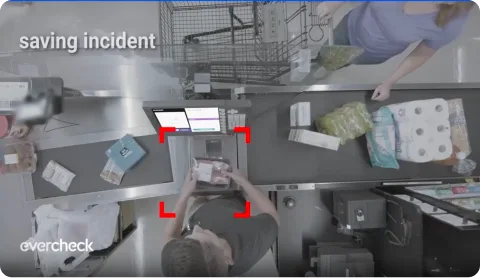
With Everseen’s Checkout Intelligence, the shopper gets a nudge on the screen: a prompt asking whether they’ve scanned all the items, along with an instant replay that shows the specific item they missed. Everything can be resolved in seconds, and the shopper at the back of the line doesn’t even realize a friction point was resolved. Over 80% of non-scans are cleared this way, and associates are only brought when support is genuinely needed.
For loss prevention efforts at checkout, there’s an even bigger benefit: Checkout Intelligence can catch patterns that a weigh scale alone can’t. It can flag over 30 unique fraud and loss patterns, so while the soft nudge keeps the line moving, loss is being recovered at checkout too.
Store Intelligence reduces shopper friction on the shop floor
Lock cases and other shoplifting prevention devices solve the problem of opportunistic theft but create real friction for shoppers who have to wait for staff to unlock them. The staff who respond to these calls are often pulled away from other important tasks, too.
Store Intelligence does not replace the need for loss prevention tech, but it does change how retailers prevent loss on the shop floor. It recognizes behavioral patterns in the aisle that are consistent with loss, so teams can see where loss starts instead of waiting for it to show up at payment.
These loss patterns may include:
- Concealment
- In-store consumption, where items are eaten or used before payment
- Multiple picks of the same product
- Excessive handling of a product
- Return visits to the same high-value shelf area
When a pattern is recognized, the retailer decides how to respond, based on its own policy. Options include an in-aisle audio alert in the moment, so staff do not have to step in, or case documentation that supports investigations.
Managers are aware of restock needs before the shelf is empty
Stockouts occur for several reasons in retail, whether that’s a forecasting error, a supply chain breakdown, or an execution gap, where merchandise is available but the shelves are empty.
The friction created here can lead to lost revenue, since shoppers can no longer buy the item.
Store Intelligence shines here because it gives teams a real-time view of availability. It alerts them when shelves are empty, when stock has run out, or when fresh items are running low.
Teams can anticipate friction points before they occur
Not all friction appears immediately, and for some, teams can trace it back to the source and act before it keeps recurring.
Checkout delays are a good example, because many begin at the shelf. Store Intelligence connects delays at checkout with the products on the shelf and flags the ones that repeatedly slow checkout. Retailers then decide how to handle it, whether that means working with vendors, changing where a product is placed, or another approach that suits operations.
Queues are another example. Sometimes, the store gets an influx of shoppers that teams aren’t prepared for. Store Intelligence measures how many customers are in the store or waiting in line, and predictive alerts warn managers ahead of a rush. Managers see the alerts and decide to open up new lanes as needed, so shoppers can get checked out seamlessly.
Zooming out to the broader estate, repeat issues that appear across multiple stores can be flagged and fixed together instead of store by store. Patterns at one store can be compared against the rest of the estate to show what is working and which stores need a closer look.
The solution to a frictionless experience is smart friction
For many retail environments, zero shopper friction is an impractical goal, especially when many measures introduced to reduce friction end up creating more. Self-checkout is the clearest example here. 50%+ of shoppers choose it when given the option, but as Joe White notes, its adoption also comes with increased losses.
Smart friction is how retailers can turn that tension into opportunity. Retailers like Morrisons are already deploying Evereen’s solution to address the trade-off between friction and loss prevention and improve the checkout experience.
Friction will never disappear from retail, but it can create opportunities for teams and shoppers alike. Contact the Everseen team to see how this can work for your estate.
Subscribe to the blog
Subscribe to Everseen's blog to receive emails about new posts and resources.