Guide to store-wide retail business intelligence
From checkout loss detection to queue analytics and estate-wide patterns, discover how retailers use Vision AI to make smarter decisions across every aisle.
Read time
10 min
Published on
Sep 22, 2026
.jpg)
Retail loss happens throughout the store, beginning in the aisle and ending at checkout. Even when retailers take steps to address it (camera deterrents, staffed aisles, a self-checkout loss prevention solution), teams often cannot see the full picture. Where is suspicious shopper behavior concentrating? How much checkout loss is being stopped each day?
Store-wide retail business intelligence helps teams answer these questions, pulling data from multiple sources across the store into one unified, real-time view of what is happening.
Retail intelligence does not stop at describing loss. It can also help teams prove the return on a loss prevention investment, plan and allocate staffing and labor, reduce shopper friction, and more.
Here is a breakdown of how it benefits different departments.
What is store-wide retail business intelligence?
Store-wide retail business intelligence is the use of Vision AI to generate a continuous, real-time view of everything happening across a store, from checkout to the shop floor. Day to day, it works like this:
- Video feeds from cameras are processed by AI models trained to recognize specific patterns and events.
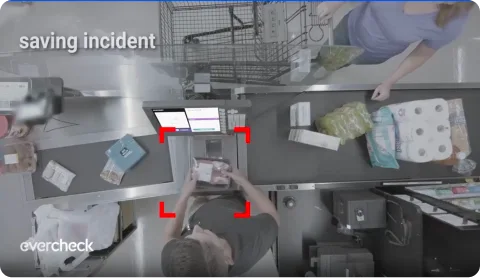
- Shopper activity at checkout is evaluated and scanned for loss patterns like non-scans or product switching.
- Customer foot traffic flow is analysed for queue buildup, checkout friction, etc.
- Several other datapoints are pulled, from store inventory to staff allocation, to form a complete view of the store.
Using retail video analytics, business intelligence gives teams a real-time view of what’s happening, where, and why. It informs decisions across loss prevention, operations, and even IT.
The core capabilities of store-wide retail business intelligence
These seven capability areas make up store-wide retail business intelligence in practice.
1. Checkout-level loss detection
This provides a real-time view of the loss events that occur at checkout and is one of the biggest uses of retail intelligence today. Research shows 4% of all self-checkout transactions involve a loss event.
For loss-prevention teams, the goal is being able to catch these losses as they occur and, more importantly, intervene in a simple, non-confrontational manner.
2. Product and customer journey analytics
This tracks how shoppers move through the store, where they pause, which products they interact with, and where that journey concludes.
In addition to feeding the store-wide intelligence layer, the data here can help teams understand what happened on the way to the register, which products are interacted with (and which products are skipped completely), and even where customer bottlenecks exist.
3. Heat maps and dwell time
These show the areas of the store where attention concentrates and how much time shoppers spend there.
Retailers can use this to understand layout effectiveness and product placement. But it can also surface patterns that correlate with loss, like repeated visits to high-value shelves or time spent in low-visibility areas of the store.
4. Queue and occupancy analytics
Measures how many customers are in the store or waiting in a queue and where bottlenecks are forming in real time. The data here can give direct insight into shopper friction and help teams act before queues compound and carts are abandoned.
5. Workforce and labour allocation
Provides data that can improve staff distribution across the store. Are there under-covered checkout lanes, congested aisles, or short-staffed high-traffic zones? The live view can help answer these questions and inform the decisions that follow.
On its own, knowing a queue is forming is only part of the picture. But you can pair that with a live read on staff coverage and turn it into a decision to open another till or redeploy a colleague already on the floor.
6. Freshness and inventory monitoring
This flags perishable stock nearing the end of its shelf life and shows teams which popular items have run out, informing restocking decisions.
Neither of these relates to loss prevention directly, but they both affect the bottom line that loss prevention teams are ultimately accountable for.
7. Hazard and safety detection
Identifies spills, blockages, and other conditions that pose a safety risk to both shoppers and staff. The data feeds into the store-wide intelligence in real time, so operation teams can quickly respond before they escalate into accidents or interrupt the shopping experience.
Store-wide retail intelligence at a glance
Beyond the store: Estate-wide business intelligence
Some Vision AI applications extend beyond data for a single store and can surface patterns across your entire estate, whether that’s two locations or 200.
With a single store’s dwell-time data, you can deduce that traffic at an end-of-aisle display is either drawing attention or creating shopper friction. But the same pattern repeated across your estate, at the same end-of-aisle display, gives your team a clearer picture and a starting point for investigation.
Estate-wide intelligence lets you spot patterns across all locations and identify what’s working, what isn't, and which stores need a closer look.
Here are a few examples showing how estate-wide intelligence adds another layer of insight to your store’s data.
- Recorded loss events: Comparing rates across every location reveals which stores are consistently outperforming and shows why. Teams get a better view of what needs addressing across the whole estate, whether that’s staff approach, labor allocation, or layout.
- Dwell time at a specific fixture type: A pattern recurring across dozens of stores turns a single-store observation into a clear signal. It can surface the stores already getting it right and the layout structures worth replicating.
- Recurring hazard type: A hazard appearing across multiple locations points to a shared cause, letting teams implement a collective fix instead of store by store.
- Queue build-up at a specific time of day: A pattern showing up consistently across the estate could point to a staffing model worth revising across the chain, instead of a single store having a busy afternoon.
Everseen's approach to store-wide retail business intelligence
Everseen has spent over a decade building Vision AI for retail. Today, 11 of the world's top 20 grocery retailers rely on Everseen to recover loss and gain the store intelligence that powers better decisions across their entire estate.
Our product range addresses different parts of retailers' store intelligence needs, combining to give a complete picture of what's happening in the store and why.
Here's how:
- Checkout intelligence: Catches loss at the till and helps shoppers self-correct in the moment. Includes real-time analytics that gives retailers estate-wide visibility into what's happening at self-checkout, broken down by loss type, zone, and store.
- Store intelligence: Extends visibility beyond the till to the shelves and aisles. Our solution identifies behavioral patterns in high-value parts of the shop floor that contribute to loss and flags them before they reach checkout. At checkout, real-time queue and staffing data are fed into store-wide intelligence, allowing teams to match staffing with demand as the need arises.
- Data intelligence: A conversational layer lets teams ask questions directly and receive answers drawn from across the platform. This is where store and estate-wide data turns into decisions that positively impact the bottom line.
Contact our team to see how loss, friction, and store performance connect across your entire operation.
Frequently asked questions
No, store-wide business intelligence does not require new camera hardware. Everseen integrates with your existing camera and POS infrastructure, so no rip-and-replace is required.
With CCTV, all teams get is a recording of what’s happened. Store-wide business intelligence processes footage in real time to identify patterns, flag events, and provide a live view of the store that teams can act on.
Yes. Everseen is GDPR and AI Act-aligned by design. No biometric data is collected, and no facial recognition is used.
Yes, store-wide business intelligence will work across different stores. Everseen's solutions adapt across both large supermarket estates and smaller convenience store formats and are currently deployed across over 10,000 stores globally.
Store-wide intelligence gives you a live view of a single store. Estate-wide intelligence surfaces patterns across all your stores and makes it possible to identify what's working, what isn't, and where action is needed across all of your locations.
Subscribe to the blog
Subscribe to Everseen's blog to receive emails about new posts and resources.


.jpg)