Grocery store loss prevention: Strategies & best practices
From spoilage to self-checkout theft, see what drives grocery shrink and the effective strategies retailers use today.
Written by
Everseen
Read time
10 min
Published on
Nov 3, 2026

A 2024 NRF survey estimates that grocery, pharmacy, and mass-merchandise retailers have some of the highest shrink rates of any retailer – 2% compared with 1.6% across other verticals.
Several factors contribute to these rates, chief among them being internal and external shrink. The NRF estimates that external shrink alone accounts for 36%, so a well-designed strategy could help reduce overall shrink by a significant amount.
First, we’ll evaluate the loss patterns that contribute to high grocery store shrink, and then evaluate how the biggest grocers are combating loss and recovering revenue.
Common loss patterns in the grocery environment
Loss in grocery retail is rarely random. It tends to follow specific patterns that can be identified, understood, and significantly reduced. Here’s a look at the loss patterns affecting grocery retail.
Spoilage, damage, and waste
Spoilage, damage, and waste in perishable product departments are one of the biggest sources of grocery shrink. One survey by The National Supermarket Research Group attributed 65% of total store shrink to perishables departments, despite those departments only accounting for 38% of sales. Fresh produce, meat, dairy, and bakery items are most affected here.
Shoplifting and organized retail groups
Shoplifters often target grocers for essentials and small items such as drinks and cosmetics. Organized retail crime (ORC) groups, on the other hand, target high-value items with resale value.
Checkout and self-checkout loss
Loss at staffed and self-checkout accounts for a large amount of retail loss, and many loss prevention efforts tend to concentrate here. A 2026 University of Leicester study discovered that store losses increase by an average of 22% after the adoption of self-checkout.
Retailers have since adopted several strategies to tackle loss at self-checkout, including smart friction.
Employee theft and transaction fraud
Sometimes shrinkage in grocery retail results from employee action. Employees might skim cash from registers, issue false refunds, void sales to conceal theft, or manipulate inventory.
Vendor and supply-chain losses
Shrinkage can also happen before the product even arrives at the store. Inventory might go missing, get damaged, or spoil during transportation, and deliveries might arrive in quantities that differ from the invoice. Vendors might also overbill, underdeliver, or manipulate transaction information.
Inventory and administrative errors
Human and computer errors when recording transactions also contribute to total loss. Incorrect stock counts, data-entry mistakes, unrecorded transfers, and improperly recorded waste can cause discrepancies between recorded and actual inventory.
5 strategies for loss prevention in a grocery store
Grocery store losses originate from different sources, whether it’s spoilage, theft, or checkout errors. As a result, no single control addresses every cause, so retailers usually rely on a combination.
Here are the common approaches and the trade-offs that come with each.
Read more: How to tackle shrink in different verticals.
Reduce perishable waste through ordering and rotation
Waste control efforts start before the products reach the shelf, and retailers often use a combination of forecasting, stock rotation, and documentation to minimize loss.
Common approaches include:
- Forecasting demand from sales history and seasonality
- Rotating stock using first-in, first-out (FIFO) or first-expired, first-out (FEFO) rules
- Marking down items nearing expiry
- Tracking waste by department to surface repeat problems
- Tightening temperature handling for chilled and frozen products
Each of these approaches has trade-offs that retailers have to manage. Markdowns, for example, can recover value but still reduce margin. Ordering less inventory cuts waste but can leave shelves empty, which has its own cost to overall revenue.
Use store layout and visible deterrence to prevent theft
Store design can reduce opportunities for theft and shoplifting. Simple changes like clear aisles with few blind spots and high-risk products placed in locked cases or visible locations can increase perceived risk and deter theft.
Staff training also plays a key role here, with workers trained to spot concealment and handle incidents without escalation.
Data from the NRF suggests that these strategies may be helping: shoplifting incidents fell 12.4% in 2025, and merchandise theft fell 8.1%.
Address checkout and self-checkout loss
Retailers have a wide range of tools for tracking and reducing loss at checkout, many of which can be monitored through analytics, whether that’s weigh scales and POS systems or exception-based reporting for staffed lanes.
Common controls used by retailers here include:
- Weight verification at the bagging area
- Attendants overseeing a bank of self-checkout lanes
- Random basket or receipt checks
- Clearer on-screen prompts for produce lookup
It’s also important to manage the limitations of each approach. Attendants, for example, can be stretched thin and miss more non-scan incidents if each individual oversees more than 4 lanes (ECR Retail Loss).
Tighten receiving and inventory accuracy
Some loss happens before products reach the shelf, caused by short shipments, damaged goods, or invoice gaps. Here, retailers use strategies including the following:
- Checking deliveries against the invoice for counts, damage, and temperature
- Tracking shortages and damage by vendor
- Running regular cycle counts, with higher-risk categories counted more often
Use exception reporting and process controls
Transaction data is a common starting point for spotting internal loss. Teams look at voids, refunds, manual discounts, and write-offs that stand out from normal patterns. 83% of retailers use exception-based reporting (EBR) for this very reason. Besides EBR, other process controls include:
- Restricting voids and refunds to authorized users
- Limiting stockroom access
- Offering an anonymous reporting line
One drawback of EBR is that it only flags transactions that fall outside normal ranges. It can’t explain why an anomaly occurred, and it can miss employee theft that stays within those ranges, so flagged items still need human review.
Taking grocery store loss prevention further with computer vision AI
Many of the controls and measures covered above have been around for a while. They address shrink and loss to different degrees, and teams have learned to work around their shortcomings while integrating them into existing workflows.
But computer vision AI is changing the way that grocery stores approach shrink and loss. It gives teams visibility across the whole store that is difficult to achieve with other technologies and can help tackle loss the moment it occurs. It can even help teams act on past patterns to prevent future loss events.
Everseen’s solution is one of the most trusted in this area. It is currently used by 11 of the world’s top 20 grocery retailers and helps stores recover $500 million in loss annually.
Here is how grocery stores use Everseen’s solution to approach shrink and loss without operation-disrupting trade-offs.
Non-scans are corrected before the shopper pays
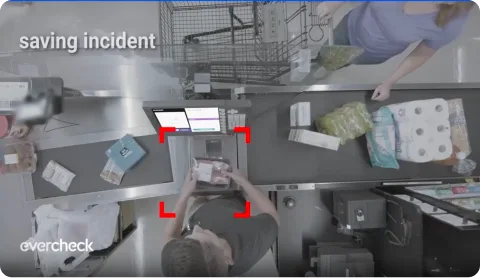
Checkout Intelligence works across self-checkout and staffed lanes and helps teams catch and address loss in real time. It integrates with existing CCTV and POS infrastructure to monitor activity at checkout. When it recognizes a non-scan, the shopper receives a Soft Nudge on screen asking whether all items have been scanned, with an instant replay of the specific item.
Over 80% of non-scan events are cleared this way. Associates are alerted only when support is genuinely needed. Across deployments, this has meant an average 30% reduction in staff interventions.
Checkout Intelligence can recognize more than 30 unique fraud and loss patterns. At staffed lanes, it can also detect sweethearting and flag incidents in reports.
Teams see where loss starts, not only where it shows up at payment
Store Intelligence helps teams track and address loss on the shop floor and can recognize shopping behaviors in the aisle that are consistent with loss. These include:
- Concealment
- In-store consumption, where items are eaten or used before payment
- Multiple picks of the same product
- Excessive handling of a product
- Return visits to the same high-value shelf area
When a pattern appears, the response depends on the retailer’s policy. This may be an in-aisle audio alert, case documentation that supports investigations, or both. In this way, store teams can accurately track and prevent loss without confrontation.
Managers are alerted when fresh stock needs attention
Store Intelligence also flags perishable stock nearing the end of its shelf life, allowing retailers to get ahead of spoilage, one of the biggest causes of grocery shrink.
It can also send alerts when shelves are empty or fresh items are running low, along with recommendations on what to do. This means teams no longer have to rely solely on monitoring every item by hand. They can instead add Store Intelligence to their toolkit.
Team access direct data from across the estate
Data Intelligence brings together information from across the store, so teams are not piecing the picture together from individual reports. It aggregates data from the sources we’ve already discussed, including transaction information from self-checkout, freshness data, and on-shelf product information from the aisles. Teams can then access operational intelligence from a single source. They can ask a question in plain English and get data-backed answers that managers can act on. That includes:
- How much was saved at checkout or in the aisles
- Where traffic is high but sales are low
- Revenue per minute of dwell, which compares zones and stores by what their floor space earns
- What a redesign could be worth before shelves are moved
Store data can be viewed for one store, a group of stores, or the whole estate. Patterns at one store can be compared with the rest of the estate to show how each store is performing relative to the others and to highlight areas that need work.
How Everseen addresses common causes of loss in grocery stores
Everseen’s solution delivers a 374% ROI for retail deployments, with a 6-month payback period. Contact our team to see how these capabilities can work alongside your grocery store’s existing approach.
Frequently asked questions
Grocery shrink is higher because it often includes goods that expire, spoil, or have to be marked down, along with theft and other shrink causes. Self-checkout is also a contributing factor, as ECR Loss reported that 96% of grocery retail had some form of self-checkout in 2022.
According to ECR Retail Loss’s 2026 research, median store shrink was about 2% at one US grocer and about 1.4% at one UK grocer. Unfortunately, there is no single figure for shrink in retail, because retailers define and measure shrink differently.
At self-checkout, customers have to scan items themselves, and that raises the chances that they make a honest mistake. Self-checkout also creates avenues for opportunistic theft, where shoppers skip scanning items on purpose.
ECR Retail Loss found an average 22% loss increase in the first year after retailers introduced self-checkout.
Everseen’s Vision AI platform covers checkout, the shop floor, and the data behind events that occur across the retail store. At checkout, it can detect non-scans and prompt shoppers to rescan, identify instances of sweethearting, and flag them for reports. It also identifies loss events across the wider store and can send alerts to team members and managers who can decide how to act before loss events complete. It is trusted by 11 of the world’s top 20 grocery retailers.
Subscribe to the blog
Subscribe to Everseen's blog to receive emails about new posts and resources.