How to reduce retail shrink across different verticals
Read about the biggest shrink risks facing retail operations, the best strategies to reduce them, and the data behind what actually works.
Written by
Everseen
Read time
10 min
Published on
Sep 22, 2026

According to the NRF, retail shrink accounted for more than $112 billion in losses in 2022 alone. The shrink problem is slightly different across various verticals, with factors like store layout, product mix, operational workflows, and checkout systems influencing how losses occur.
As a result, each retail sector needs different prevention strategies and monitoring tools to fit their specific environment.
This guide breaks down the biggest shrink risks across major retail verticals and shows business owners how to tackle them using modern prevention systems.
Understanding shrinkage in different retail verticals
Shrink is a constant across retail, but it changes between business types. A fashion retailer and a convenience store may both deal with external theft, but loss will concentrate around different products and have varying impacts on their bottom line.
Understanding where your vertical is most exposed can help establish a prevention strategy that fits your specific operations.
Below is a breakdown of the biggest drivers of shrink in retail and how they affect different retail operations.
External theft
This is the most visible cause of shrink and, according to the NRF, the largest share as well, representing 36%.
Some verticals tend to lose more to external theft than others, particularly grocery, big-box, fashion, and health and beauty stores. In these environments, products that are high-value and easy-to-conceal can be slipped off the shelf and out the door undetected.
Employee theft and internal shrink
Theft, fraud, and policy abuse carried out by employees and contractors make up 29% of all retail shrink. They tend to prevail in environments where cash handling and supervisor overrides are common place, like grocery and convenience stores. In fashion and general merchandise, retailers tend to see more product diversion and fraudulent returns.
Read more: Preventing Internal and External Theft.
Self-checkout loss
Self-checkout can create opportunities for both intentional and unintentional loss to thrive. Here we see missed scans, product switching, or items deliberately left at the bottom of the cart. Stores with self-checkout implemented see an average of 22% increase in loss after implementation, based on ECR Loss’s Self-Checkout Report.
This kind of shrink concentrates in verticals where SCO counters are rolled out, like grocery, convenience, and big-box outfits.
Administrative and operational loss
27% of all retail shrink is attributed to administrative and operational loss. This includes paperwork errors, inventory miscounts, pricing mistakes, and even receiving errors. Administrative loss will affect every vertical to a varying degree. But grocery retailers are particularly exposed because of the pace of their replenishment cycles and the volume of daily receiving activity.
Return and refund fraud
This involves exploiting gaps in a retailer's return policy to obtain credit or cash. It is prevalent in verticals with high-value, non-perishable products like fashion, health and beauty, and general merchandise.
Vendor and supply chain shrink
Supply chain shrink involves loss that occurs before goods even reach the shop floor. It is most common among grocery, big-box, and pharmacy retailers. Generally, this type of shrink thrives where delivery discrepancies and shipping errors are commonplace.
These retailers also tend to have complex supply chains and distribution networks; they make it easier for this type of loss to thrive.
Breaking down shrink patterns across different retail sectors
Strategies to reduce shrink across all retail verticals
The median shrink rate in retail verticals is 1.4%, with some industries climbing as high as 3.5%. Retailers already operate with thin margins, so reducing shrink by even a few percentage points can mean the difference between a profitable year and a loss.
To reduce shrink, retailers often use a combination of technology solutions, traditional loss prevention strategies, and organizational restructuring. Here are the most effective ones.
Storewide visibility and better product placement
A store's physical layout has a direct influence on where and how loss occurs. For example, high-risk products placed in low-traffic, low-visibility areas are more susceptible to concealment. The fix is positioning them closer to staffed zones or well-monitored checkout areas to reduce opportunities for theft, without adding extra operational friction.
CCTV, a staple of retail security, is also a critical addition here. It provides visibility to blind spots and, more importantly, acts as a visible deterrent.
Inventory accuracy and back-of-store controls
Roughly a third of all retail shrink comes from operational failures, and tightening back-of-store operations can pay dividends here.
Steps could include using credentials to limit access to receiving bays and employee entrances. This also makes it easier to track movements and connect individuals with events.
Produce waste reduction
In grocery retail, spoilage and expiry cut into margins, and reducing waste here can sum up to big wins for the bottom line.
One way to reduce this type of shrink is by moving beyond annual or quarterly demand forecasting to weekly or daily predictions. These can inform ordering volumes more precisely. Using sales data and foot traffic patterns to optimize product display and rotation can also prevent overstocking and reduce spoilage.
An example of this is Eden, Walmart’s internal “freshness algorithm” tool. Eden was created to help staff manage perishables and extend shelf life before products are lost to spoilage. After launch, the tool was projected to save Walmart $2 billion over 5 years.
RFID and EAS tracking
Item tracking is a widely used strategy in high-value verticals like fashion, electronics, and health & beauty. Two effective tools here are Electronic Article Surveillance (EAS) tags and RFID tags. EAS tags will trigger exit alerts when items leave without being deactivated at checkout, stopping loss before the customer walks out.
With RFID, products can be tracked from delivery through to point of sale, providing visibility that makes it harder for loss to go undetected anywhere along the customer shopping journey.
Data from ECR Loss shows how effective RFID can be, with one retailer reporting a 15% reduction in shrink losses. Consistent implementation was also shown to increase inventory accuracy from the 65–75% range to 93–99%.
Vision AI and Everseen
Vision AI brings a new layer of intelligence to loss prevention. Everseen’s own Vision AI solution has helped retailers generate over $500 million in extra sales from recoveries across its global deployments.
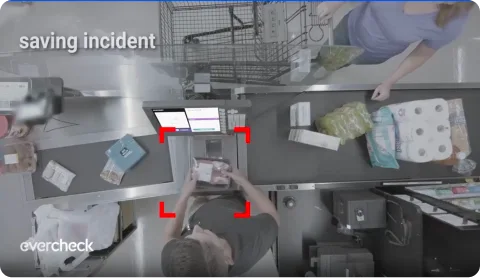
The real advantage here is real-time monitoring. At the point of sale, Everseen can identify over 30 patterns of loss, including missed scans, product switching, and other transaction irregularities across all open lanes simultaneously. On the shop floor, it can identify behavioral patterns like concealment in high-value aisles.
The system is also able to softly nudge the shopper – a screen prompt at SCO and an audio notification in the aisles – to self-correct, all without staff intervention.
In practice, stores using Everseen see a 30% reduction in staff interventions at self-checkout and a 30% increase in loss recovery, without adding friction to the customer experience.
Building a shrink reduction plan
Shrinkage is a constant in the retail industry, but thankfully, lots of strategies exist for reducing it, many of which we’ve shared in this guide.
The next level of shrink reduction for retailers is Everseen’s Vision AI solution, bringing real-time loss detection to several aspects of the store operations simultaneously. The power here is the flexible application. Everseen can be deployed across various verticals where there are POS systems, high-value aisles, and preventable loss patterns.
Contact our team to see how Everseen can fit into your store’s shrink strategy.
Subscribe to the blog
Subscribe to Everseen's blog to receive emails about new posts and resources.



.jpg)