How retailers stop skip-scanning in the modern store environment
Skip scanning is a common self-checkout loss pattern. Learn how retailers address it and which strategies work best
Written by
Everseen
Read time
10 min
Published on
Oct 14, 2026

Skip-scanning happens when a customer intentionally or unintentionally fails to scan items at self-checkout and leaves the store without paying for them.
It is a type of non-scanning, the broader category covering any item that passes through checkout without being scanned. Skip-scanning has been a common loss pattern for retailers since self-checkout was introduced, and self-checkout now contributes up to 23% of total unknown retail losses.
Here’s why skip-scanning happens and why much of it isn’t due to deliberate theft.
Why is skip-scanning prevalent in retail today?
Missed scans are common at self-checkout and occur in between 1% and 4.8% of all self-checkout transactions. Skip-scans are only possible at self-checkout because the shopper, not a cashier, is responsible for scanning every item. The closest pattern at staffed checkout is sweethearting, where employees deliberately skip scanning items for friends, family, or themselves.
Most skip-scanning comes down to five factors:
- Genuine errors: Shoppers get distracted, rush, or lose track of what they've scanned, especially with large baskets, children, or a phone in hand.
- Customer confusion: Unfamiliar screens and unclear prompts lead shoppers to assume an item scanned when it didn't.
- Hard-to-scan items: Bulky, awkwardly packaged, or damaged-barcode items are easy to leave in the cart and skip.
- Software errors: Scanner misreads or screen lag can leave an item unregistered without the shopper noticing.
- Opportunistic shoplifting: Self-checkout offers privacy and fewer watching eyes, so some shoppers leave items unscanned on purpose.
Modern retailers tackle this problem with a mix of traditional loss prevention strategies and newer technologies. But many of these either have limited effectiveness or trade one retail problem for another.
Strategies retailers use to stop skip-scanning
No single loss prevention strategy can catch every missed scan event, but some come closer than others.
Weight verification and weigh scales
Weight verification is one of the oldest and most widely used controls against retail shrink and loss in general, and it is particularly effective at self-checkout stations.
The system compares the expected weight of the product scanned with the weight placed in the bagging area. If there is a mismatch, the checkout station typically stops the transaction and alerts an employee.
Weight scales have their own limitations: They are prone to false positives, which can frequently halt the transaction flow and allow queues to build.
Any number of things can set off the alert:
- An item placed in the wrong location.
- A product switched between bags.
- Discrepancies between the product's expected weight and actual weight.
Constant alerts can also make it harder for employees to catch real loss events when they occur.
Increased supervision
According to an ECR loss study, supervisors with more checkout lanes are less likely to say they can effectively supervise them, and the study recommends no more than four lanes per supervisor.
Skip-scanning events are also easier to miss than patterns like obvious barcode switches because the items can simply be left in the basket or concealed physically.
Increased supervision, especially when the store is busy, is an easy way to cut down on loss at the self-checkout lanes, but it’s far from perfect. Attendants are likely to miss some non-scans, regardless of how many lanes they have to monitor.
Store layout and visible deterrence
Some retailers design self-checkout areas around visibility and staff presence. The aim is to give employees a clear view of the checkout area so they can help customers quickly and minimize the likelihood of loss happening in the first place.
These areas often include public view monitors and CCTV-linked displays, so staff can see transactions as they happen. The layout is typically open and clearly defined, with simple paths in and out. That makes it easier for staff to notice when a customer needs help and harder for loss to go unnoticed.
While the design doesn’t identify skipped scans themselves, it can reduce the opportunity for most self-checkout loss patterns and ensure a supervisor can step in to help customers when skip-scans occur.
Random checks and basket audits
With random checks, customers are told that their purchases may be reviewed before they leave. The possibility of a check encourages everyone to scan carefully and double-check for missed or skip scans. Basket audits are especially common with Scan & Go systems, where customers scan items on their phones while shopping instead of at a fixed checkout.
Like every loss prevention strategy, these come with trade-offs, with the biggest being the customer experience. Being stopped for a check can feel like an accusation, even when it's random, and can leave honest customers embarrassed or frustrated. In some cases it can even lead to confrontation, putting both customers and staff in an uncomfortable position.
There are also practical limits. Checks happen after the fact, so they don't catch loss as it occurs, and they reveal little about how, when, or why it's happening.
Exit validation
Exit validation is a strategy that works best as part of a greater loss-prevention effort rather than a standalone solution.
Depending on the store and technology being used, employees or security personnel may validate receipt or otherwise confirm a customer’s purchases before they leave.
This can catch losses that earlier controls did not identify. For example, a missed scan that was not detected by the checkout system or an employee could potentially be identified during exit validation.
As with basket audits, however, exit validation introduces another point of friction into the customer’s journey. Retailers need to consider if it’s worth the trade-off.
Read more: Retailer’s guide to loss prevention at SCO.
Stop skip-scanning with Everseen’s Checkout Intelligence solution
Traditional skip-scanning strategies can help retailers deter, identify, and even recover loss, but they have the same limitations. They either depend on employees noticing the event in real time and responding or rely on technology that generates a high rate of false positives, such as weigh scales.
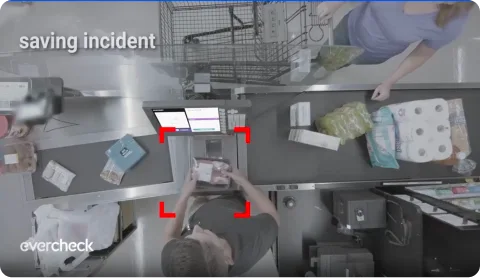
Vision AI takes a different approach. Everseen's solution learns from more than 15 million retail transactions every day and identifies non-scan events, including skipped scans, at the checkout in real time. It works with existing cameras and most modern POS systems and can integrate seamlessly with your current infrastructure.
Everseen's Checkout Intelligence solution recognizes skip-scanning and 30+ unique loss patterns. When it detects one, staff do not need to step in right away, and in most cases they do not need to step in at all.
Instead, shoppers see a Soft Nudge on screen. It is a prompt asking whether they have scanned all their items, with an instant replay that shows the specific item that was missed. In over 80% of the time, this is enough to stop the loss event. Because the prompt points to the exact item and lets shoppers correct it themselves, staff are brought in only when support is genuinely needed.
Everseen can handle more than skip-scanning
Stopping skip-scanning is just the start of what Everseen can do. The system is built to help prevent loss across your business and, more importantly, give teams data-based insights into what’s happening across the estate.
That includes:
- Data intelligence that provides real-time analytics of store performance broken down by loss type, zones, alert patterns, and attendant interaction levels.
- Queue prediction and lane optimization systems that help managers decide how many lanes to open to minimize queue formations and improve the customer experience
- Better decision-making via conversational AI, where teams can ask questions in plain language and receive insight based on estate data
11 of the 20 biggest grocery retailers in the world trust Everseen, and it’s deployed across 10,000 stores worldwide. Annually, it helps businesses recover more than $500 million in sales.
Contact our team to see how Everseen can help your estate address SCO loss patterns like skip-scanning.
Subscribe to the blog
Subscribe to Everseen's blog to receive emails about new posts and resources.


.jpg)