The complete guide to shrink and loss prevention for retailers
A complete guide to retail shrink: its sources, how self-checkout impacts loss, and the strategies (including Vision AI) that reduce it.
Written by
Everseen
Read time
10 min
Published on
Sep 22, 2026

Retail shrink costs the industry over $112 billion annually. Despite decades of investment in loss prevention, it has remained a persistent cost for retailers to manage. The self-checkout rollout has also added a new variable. As it handles a growing share of transactions, loss patterns have emerged that conventional prevention measures aren’t designed to catch.
In response, the tools retailers use have now evolved. Vision AI systems can now monitor every transaction continuously, in real time, and act before payment completes. This is a meaningful shift for retailers, going from auditing loss after it occurs to intercepting it in the moment.
This guide covers the full picture:
- What retail shrink is and how it is measured
- Where retail shrink originates
- How self-checkout has changed the loss landscape
- The strategies retailers use to reduce shrink
- Where traditional loss prevention reaches its limits
- How Vision AI is powering more effective shrink reduction today
What is retail shrink?
Retail shrink is the loss of inventory between the time it is bought from a supplier and the time it is sold to a customer. It represents the gap between the inventory retailers expect to have and the inventory they actually hold.
Shrink in retail is different from planned write-offs, customer returns, and markdowns because the latter are all accounted for in normal operations. With shrinkage, the stock goes missing without a record of where it went or why.
How is shrinkage measured?
Retailers measure shrink as a percentage of total sales, and it’s calculated using the following formula:
(Recorded inventory value − Actual inventory value) ÷ Total sales × 100
The average retail shrink rate is approximately 1.4–1.6% of sales, according to the National Retail Federation. That means a retailer turning over $500 million annually at a 1.5% shrink rate is absorbing $7.5 million in losses.
Even minor improvements in shrink rates can significantly improve the bottom line. For the same retailer, reducing shrink from 1.5% to 1.4% saves $500,000, without any additional sales.
The sources of shrink in retail
According to the NRF, there are 4 primary sources of shrink for retailers. They are present across all verticals, even though the share varies between operations.
External theft
External theft includes shoplifting and Organized Retail Crime (ORC), and makes up the largest share of shrink for most retailers, estimated at 36%. Sometimes, external theft involves opportunistic shoplifting: a product concealed or slipped into a bag before reaching checkout. Other times, it’s as a result of ORC groups, where coordinated individuals target high-value products and resell them for a profit.
Employee theft
Employee theft is also known as internal theft, and this source of shrink is harder to detect because it blends into normal store activity.
It may include sweethearting (when cashiers don’t scan items for friends or familiar individuals), cash mishandling, or merchandise theft. All of these are challenging to trace in the transaction data without the right retail video analytics systems in place. It represents 29% of shrink for most retailers.
Process failures, vendor errors, and operational loss
Not all shrinkage is due to theft. The NRF attributes 27% of retail shrink to process failures, control gaps, and errors. This covers a wide range of events.
At the operational level, it includes administrative mistakes like pricing errors, mislabeled products, incorrect receiving counts, and POS input errors. It also includes losses that occur before stock reaches the shop floor, like substituted products and invoice discrepancies.
Other sources of shrinkage, like damage in transit or on the shop floor and product spoilage, fall into this category too. These types of shrinkage are more prevalent in grocery and fresh food retail.
The problem with this category of loss is that it can easily be conflated with other shrink sources during reporting, making it harder to isolate and address.
Unknown loss
The NRF attributes the remaining 7% of shrink to unknown loss, i.e., events recorded in the data but can’t be assigned to a specific cause. This category exists partly because of the reporting limitations of traditional shrink measurement. It identifies another problem with retail shrink – without real-time visibility, some loss events can’t be identified, classified, or even addressed.
How self-checkout contributes to retail shrink
Currently, more than half of shoppers will choose self-checkout when given the option, and in most grocery and general merchandise formats, SCO now handles a significant share of daily transactions.
Unfortunately, that means loss patterns that appear in self-checkout also become more prevalent.
ECR Retail Loss found that loss makes up 4% of all SCO transactions, at an average value of approximately £3.80 per incident. Shrink rates at SCO are also much higher, at 3.5%, compared to the 0.2% seen at staffed lanes.
Several factors explain why.
Some loss patterns are specific to SCO
At a staffed checkout, a trained cashier controls the scanning process and can catch errors before they occur.
At self-checkout, the customer is in charge, and that creates room for both genuine mistakes and deliberate loss. Patterns like non-scans, product switching, and abandoned transactions are all specific to the self-checkout environment.
Traditional loss prevention measures weren't built for SCO
Most of the loss prevention infrastructure retailers rely on is designed for staffed checkout. At a staffed lane, the cashier handles every item and runs the transaction, and their presence alone acts as a deterrent. Loss prevention systems were built around that model (exception reporting, supervisor alerts, and attendant training) because a team member will always be in the transaction chain.
With self-checkout, the conversation is different. There is no cashier to catch a missed scan, and no trained eye moving from item to item. Associates are present, but they often cover multiple checkout lanes, making it hard for them to catch any single suspicious transaction.
And even when they identify a loss pattern, intervention can create friction.
The challenge with loss at self-checkout is creating visibility so that intervention is possible the moment loss occurs, without disrupting the customer experience that made self-checkout valuable in the first place.
Top Loss prevention strategies in retail
Loss prevention has evolved well beyond a security guard at the door. Today, retailers use strategies that fall into four broad categories:
- Technology: This includes CCTV, electronic surveillance, RFID tagging, and increasingly, AI-powered loss prevention solutions. Technology-based strategies are where a large portion of investment goes (61% of retailers have increased their software budgets for loss prevention) because they can largely scale with the problem.
- Employee training and awareness: Store teams are often the first to notice something is wrong, and training ensures they can recognize loss patterns, respond appropriately, and work effectively alongside the technology installed in the store.
- Inventory management and audit cadence: Regular stock counts, reconciliation processes, and vendor verification are not glamorous, but they help identify a significant proportion of shrink. The faster discrepancies surface, the sooner they can be investigated and addressed.
- Store environment and layout: This involves creating clear sightlines, adequate lighting in high-value zones, and thoughtful product placement to minimize opportunistic shoplifting and increase perceived risk.
Below, we share the best strategies that retailers are using across all four pillars.
1. CCTV and video surveillance
Closed-circuit television remains a standard part of any loss prevention setup. Cameras can cover entry and exit points, the sales floor, and self-checkout zones, providing footage for audits and internal investigations.
2. Inventory management and cycle counts
Regular stock counts, both full and partial, are one of the most straightforward tools in a loss prevention program. Frequent cycle counts can catch discrepancies earlier and make it harder for losses to accumulate. Combining count data with sales and receiving records helps identify where in the supply chain loss is occurring, so teams can focus their attention where it matters most.
3. Electronic article surveillance (EAS)
EAS tags are very useful for preventing the loss of specific high-value items. The tags serve as a deterrent and will trigger an alarm at the exit if not deactivated at the point of sale and can be very effective against opportunistic shoplifting.
4. Exit controls and receipt verification
Exit controls are one of the oldest loss prevention tools, but receipt verification at the self-checkout exit is seeing renewed focus as SCO shrink becomes harder to address at the POS.
At their most basic, exit controls involve a physical or staffed checkpoint between the sales floor and the door. This may involve security gating, turnstiles in high-theft environments, or staffed exit points.
Receipt verification adds another layer to this and is standard practice in warehouse and club formats like Costco.
5. Store layout and product placement
Store layout can make theft easier or more difficult to execute. To reduce loss, high-value items are typically positioned in locked cabinets or in clear line of sight of staff, and having wider, well-lit aisles reduces blind spots.
Retailers also use end-of-aisle placement for high-theft categories, bringing traffic past visible areas.
6. POS exception reporting
Point-of-sale exception reporting flags unusual transaction patterns at the till. These may include voids, refunds, no sales, and repeated price overrides and can be a sign of either error or deliberate manipulation. Exception reporting software is used to identify these anomalies automatically and choose which ones demand additional investigation.
7. Staff training and culture
Employee awareness cuts across nearly every shrink reduction strategy. Staff interact with the technology, layout, or audit systems put in place and can even help identify anomalies early.
Training typically covers theft recognition, safe intervention procedures, and the importance of consistent process compliance. Beyond formal training, the culture in a retail organization also affects how seriously loss prevention is treated in stores.
The limits of traditional loss prevention in reducing shrink
The strategies above are effective at reducing theft and loss on some level. But in today’s retail environment, and SCO especially, their effectiveness is reduced. As customers scan items and complete transactions with less staff interaction, the opportunity for theft and loss has grown beyond what standard measures can influence.
Here are the four major ways traditional loss prevention falls short in today’s retail environment:
They are reactive by design
Most traditional LP tools either capture evidence of loss or provide evidence for investigating; they do not stop the loss itself.
CCTV footage is reviewed after an incident. POS exception reporting surfaces patterns after transactions close. EAS alarms sound at the exit, after goods have already been concealed.
In each case, the loss has already occurred by the time the system responds. For prevention, retailers need to stop loss before the transaction completes, and very few conventional tools can do that.
They do not scale with self-checkout growth
This is perhaps the most important limitation for modern retailers. With a cashier at a staffed lane, transactions are processed one at a time with natural oversight. But a single SCO attendant can oversee four, six, or more lanes, which makes that level of oversight harder to accomplish.
Transaction data is available but not used in real time
Retailers generate significant volumes of POS and inventory data. Exception reporting tools can surface patterns, but typically on a weekly review cycle and after the fact. By the time the data flags an anomaly, the loss could have accumulated across several dozen transactions.
Physical deterrents aren’t perfect
Locked display cases, bag checks, and exit verification all put staff in difficult positions with customers, create friction, and even suppress sales (in the case of locked cases where customers don’t want to wait for assistance).
Reviewed together, we can see that these measures have a performance ceiling. That's why retailers today are turning to a different class of intervention.
Computer vision and Vision AI for retail loss prevention
Computer vision is a field of artificial intelligence that allows machines to interpret and understand visual information. In a retail context, that means feed from cameras can be used to identify products, detect scanning behavior, track items through a transaction, and flag anomalies in real time.
Vision AI takes this further by applying it to retail transactions and shrink use cases. Systems trained on millions of real loss events are able to detect anomalies and assess context, determine the appropriate response, and execute it, all before the transaction closes.
Let’s break down how that works in practice.
How Vision AI operates in the retail environment
Vision AI monitors activity continuously across the zones it covers, whether that is a checkout lane or a high-value aisle. At a self-checkout or staffed lane, the system tracks each item from the moment it enters the bagging area through to payment. It can detect a scan that did not register, an item placed in a bag without passing over the scanner, or a product switch where a cheaper item is scanned instead of a high-value one.
In each context, it tracks what is happening in the frame, compares it with millions of real retail events in its training data, and identifies anomalies that warrant a response.
Vision AI can differentiate contexts and act accordingly; that’s what sets it apart from passive surveillance. The system doesn’t flag every anomaly. Instead, it assesses whether a deviation is meaningful and consistent with loss patterns. And even for events that pass this threshold, staff intervention isn’t always the first action. Sophisticated vision AI systems can send a simple prompt that allows the shopper to autocorrect, avoiding friction and staff confrontation.
Edge processing: The infrastructure behind real-time processing
For Vision AI systems to flag loss behaviors before the transaction closes, speed is critical. And that means processing information at the edge – running AI models on hardware located inside the store.
Analysis happens locally in milliseconds, making it possible for intervention (either automatic or staff involved) to happen before the transaction is complete. Edge processing is what makes real-time intervention technically viable, and it also means that raw video footage does not need to leave the store.
The advantages of Vision AI over conventional approaches
Here’s a breakdown of how Vision AI provides better shrink and loss prevention vs. traditional methods.
- It intervenes before the transaction closes, not after the loss has occurred.
- It covers every lane, every transaction, continuously—without costs rising in step with SCO penetration.
- It acts on ambiguous events that produce no clear theft signal, not just on obvious ones.
- It reduces reliance on constant staff monitoring and only escalates when genuinely needed.
How Everseen addresses retail shrink and loss prevention
Everseen is a Vision AI platform operating across more than 150,000 live checkouts worldwide, analyzing 15 million transactions every day. The platform addresses loss and informs operational performance across the full shopping journey, from the aisle to the checkout.
Checkout revenue recovery: Evercheck
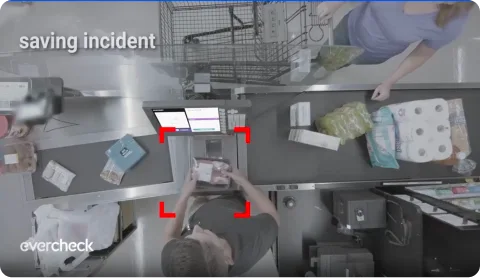
Evercheck is Everseen’s self-checkout loss prevention solution. It monitors transactions in real time, identifying loss events as they happen and resolving most of them before payment completes. Evercheck can detect more than 30 unique fraud and loss patterns, including non-scans, product switching, and abandoned transactions.
When these patterns are identified, it responds with a Soft Nudge – a screen prompt that invites the customer to self-correct. More than 80% of non-scan instances are resolved this way, without staff involvement.
Aisle-level loss prevention: Evershelf
Much of retail loss begins before the shopper reaches the checkout, and Evershelf addresses these types of loss at the point of occurrence. The solution can monitor behavioral patterns across high-value, high-risk aisles in real time, watching for behaviors that are consistent with loss.
When it detects patterns like concealment or unusual repeat visits, the shopper receives an in-aisle audio alert notifying them they are being recorded.
Checkout-area operations: Evereagle
Evereagle gives retailers real-time visibility of their checkout zone, including customer flow, queue length, and wait times. Using data from cameras, it forecasts how many lanes need to be open and by when, based on the retailer's own service level rules. Then, it notifies floor leaders live so they can act before queues build.
It runs on the same server infrastructure as Evercheck, so it can be added to existing deployments without a separate installation.
Store-wide retail business intelligence
Loss prevention decisions are only as good as the data behind them. Everseen's retail business intelligence layer pulls data from across the store into a single, real-time view: what is happening at checkout, how shoppers are moving through the aisles, where queues are forming, and where loss is concentrating.
Beyond the individual store, the intelligence extends across your entire estate. Patterns that look like a single-store anomaly often tell a different story when repeated across dozens of locations, whether that is a recurring loss type, a layout issue, or a staffing model worth revisiting chain-wide.
This gives LP teams and store leadership a picture they cannot get from individual tools operating in isolation.
Conclusion
Retail shrink is not a new problem. What has changed is the environment in which retailers are trying to solve it; self-checkout rollouts, leaner staffing, and larger store footprints all affect how traditional loss prevention measures stop shrink.
Vision AI addresses the gaps that these traditional measures can’t. It processes every transaction continuously, acts before the sale closes, and generates meaningful actionable insights for teams based on the observed data.
The question for retailers managing shrink across a large estate becomes, which Vision AI platform can be trusted to deal with the modern realities of shrink? And for 11 of the top 20 retailers globally, the answer is Everseen.
Contact our team to see how Everseen fits into your shrink reduction strategy.
Frequently asked questions
Retail shrink is the difference between the inventory a retailer expects to hold and the inventory it actually has. It represents stock that has left the business through theft, error, fraud, or damage without generating revenue.
The industry benchmark puts shrink at 1.4–1.6% of sales. That means up to £8 million in losses each year for a retailer with an annual turnover of £500 million.
Most retail shrink is a result of external theft (36% of shrink), internal theft (29%), and process failures and administrative errors (27%). Theft, both internal and external, represents nearly two-thirds of total losses.
Self-checkout removes the cashier as a control point. As the customer scans, bags, and confirms their own transaction, there’s greater opportunity for missed scans, product switching, and intentional non-payment. SCO shrink rates are approximately 3.5% compared to 0.2% at staffed lanes.
AI-powered Vision AI systems monitor transactions in real time and detect anomalies, including missed scans, weight discrepancies, and product switching. These are identified and flagged as they occur and are superior to passive CCTV because they make real-time intervention possible.
Subscribe to the blog
Subscribe to Everseen's blog to receive emails about new posts and resources.



.jpg)