The retailer's guide to self-checkout loss prevention
Self-checkout drives more shrink than staffed lanes. This guide breaks down why, how operations are affected, and how retailers can respond.
Written by
Everseen
Read time
10 min
Published on
Sep 22, 2026
.jpg)
Self-checkout was adopted to be a win-win: faster lines for shoppers and lower labor costs for retailers. Instead, it's increased the opportunities for loss.
Stores with self-checkout lose more to shrink than stores without it, and high-profile pullbacks from the biggest retailers have raised the question: is self-checkout worth the loss it creates?
The answer isn't to remove self-checkout altogether because it speeds up the shopper journey, has a strong ROI case, and, according to ECR Retail Loss, 54% of shoppers will choose it when given the option. What retailers need is a solution that gives real-time insights into loss as it occurs and empowers their teams to act immediately.
But first, let’s break down the dynamics of loss at self-checkout.
The scale of the self-checkout loss problem
Retail shrinkage costs the industry billions every year, and for many retailers, self-checkout compounds the loss problem. Stores with self-checkout average 1.96% shrinkage compared to 1.35% in stores without it. Research from ECR Retail Loss also shows that introducing self-checkout is associated with a 22% increase in store loss.
Most of these losses stem from the very nature of self-checkout: retailers gain cost efficiencies from fewer attendants on the floor, but that comes at the cost of oversight.
Additionally, the picture of loss at self-checkout is a lot more nuanced than "self-checkout rollout equals reduced revenue for retailers." Understanding where loss comes from and why, is the first step to addressing retail loss and unlocking self-checkout's full potential.
We cover the full breakdown of retail shrink data in our retail shrink statistics roundup. Here, we focus specifically on what is happening at self-checkout and what retailers can do about it.
Self-checkout is here to stay
In recent years, a number of high-profile retailers have scaled back their self-checkout operations. Walmart and Booths have scaled back their SCO deployment, citing problems with shopper experience and increased loss.
These decisions attracted significant coverage and raised a burning question for many retailers: is self-checkout worth the trouble?
There are clear tradeoffs between staffed and self-checkout, increased loss being the biggest one. But data also suggests that SCO is worth it for many retailers. More than half of shoppers choose self-checkout when given the option.
Plus, the global SCO system market is growing and is projected to pass $17 billion by the early 2030s. Retailers have invested heavily in the infrastructure, and the economics that made self-checkout attractive in the first place have not changed: fewer cashiers, faster throughput, and lower labor costs.
So the fix isn’t rolling back self-checkout and removing all the benefits – afterall, even stores with staffed checkouts see shrinkage. As Everseen CEO Joe White puts it, “Shrink has too often been treated as just part of doing business, something for store teams to absorb rather than enabling a more controlled, safer environment.”
The real fix is figuring out how to run SCO in a way that reduces loss.
How loss occurs at self-checkout
Not all self-checkout loss looks the same. Before retailers can address it effectively, it helps to understand what is actually happening at the terminal and why.
The most common shrink and loss patterns at self-checkout include:
- Missed scans: This covers items that pass through without being scanned, whether accidental or deliberate.
- Product lookup (PLU) errors: Mis-keying codes for produce and bulk items.
- Items left in the cart or basket: Goods that never make it to the scanner at all.
- Barcode switching: Swapping a cheaper item's barcode onto a pricier one.
- Payment walkaways: Customers leaving after a failed or incomplete payment.
But how much of SCO loss is intentional, and how much is due to genuine customer error?
Research by the ECR Loss Group found that 52% of retail shrinkage is accidental, compared to 48% attributed to malicious intent. At self-checkout specifically, missed scans occur between 1% and 4.8% of all transactions, with causes ranging from unfamiliar interfaces to items that don’t scan immediately.
Data from self-checkout loss prevention solutions also aligns with this. Everseen found that when shoppers receive a gentle on-screen prompt to rescan a missed item, between 80% and 97% do so immediately.
As White puts it: "Many missing and incorrect scans are innocent mistakes, experience has shown, and this procedure corrects those mistakes simply and immediately." The procedure being a Soft Nudge prompt on screen that resolves most non-scans without staff intervention.
And this is the key with self-checkout loss: it is a mix of both accidental and deliberate loss patterns, so the best approach needs to take that into account. The solution needs to be accurate enough to tell the difference between both types of loss events and fast enough to act before the transaction closes.
Self-checkout presents more than just a shrink problem
Shrinkage is one of the biggest concerns with SCO for most retailers, but it is only part of the picture.
The process of reducing it can create friction for shoppers and store teams alike, and that friction can make up its own kind of loss.
Shopper friction
Errors in the self-checkout process are the primary source of this, as they can add frustration to an otherwise seamless shopping experience. Occurrences like unrecognized barcodes and weight sensor mismatches can trigger alerts that stop the transaction and require staff intervention.
41.8% of shoppers say they expect a slower checkout process with SCO, the opposite of the convenience SCO is supposed to provide.
Purchases with age restrictions can add another layer of friction here. Shoppers looking to buy alcohol, tobacco, or goods in the similar category will generally require a staff member to verify their age.
These friction points are generally understood, with most self-checkouts restricted to 10 items or lower to maintain speed and pace. And, the general sentiment is that it’s bad etiquette to bring alcohol to self-checkout.
Individually, these interruptions are minor. But multiplied across thousands of daily transactions, they translate into abandoned purchases, shopper attrition, and revenue that never gets captured as "shrink."
Staff friction
A single attendant is often responsible for monitoring several SCO lanes at once. When they go to resolve an issue at one lane, every other lane they're responsible for goes unsupervised. That means a greater chance for loss patterns to surface – mis-scans, walkaways, etc. Additionally, any shopper waiting for help elsewhere has to wait longer.
The actual step of resolving accidental and deliberate scans can add another layer of tension here. Even when staff approach shoppers to resolve it quickly, the shopper may feel accused or attacked, and the interaction can leave some friction behind. Addressing deliberate loss patterns particularly, can put staff in a confrontational position.
A Harvard/SHIFT project report found that workers in stores with self-checkout are 14% more likely to never or rarely be treated with respect by customers and 12% more likely to be bullied in customer interactions.
These friction points are closely tied to how self-checkout works today, and they're likely to persist as long as shrink and loss remain a challenge.
But that doesn't have to be the case. Vision AI can change the loss dynamic in SCO, and with it, how shopper and staff interactions play out.
Vision AI in Retail: A modern solution to the SCO loss problem
In the modern retail environment, the challenge with loss prevention is the ability to act and respond to loss events in real time, at scale, without adding friction to the shopper journey or staff workflow.
Vision AI addresses all of these challenges with minimal trade-off and a proven ROI track record. It changes the game for how retailers integrate self-checkout and even how they address loss in general.
Vision AI runs on computer vision, the ability of software to analyze, interpret, and extract meaningful data from images and videos. Vision AI in a retail context is able to analyze in-store footage continuously and provide actionable data. This is sometimes called retail video analytics.
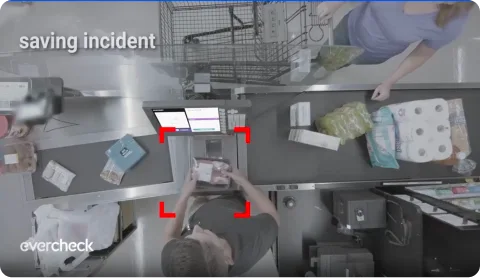
Everseen’s Vision AI solution was purpose-built for the retail environment and designed to integrate with how retail teams already operate. Our flagship product, Evercheck, operates at checkout and is able to identify over 30 loss patterns, including genuine user error and deliberate attempts at shoplifting.
In the next section, we break down how Vision AI transforms self-checkout, removing the loss-based limitations that have previously limited its application and use.
How Vision AI transforms self-checkout
Retail applications of Vision AI serve the entire store but is particularly useful at self-checkout, where they have been proven to generate 374% return on investment, with payback in under six months. Here’s how these applications look in a day-to-day setting.
Recovering loss at the point it happens
Evercheck is able to detect loss behaviors in real time and move to resolve them immediately. Rather than identifying loss in a weekly shrink report or a post-hoc audit, all instances are flagged in the moment, and resolution follows.
The solution is able to identify 30+ loss patterns at checkout, including:
- Non-scan incidents
- Basket-based loss
- Abandoned transactions
- Cart-based loss
- Product switching
The soft nudge: assuming positive intent
When loss patterns are identified, resolution follows in the form of a soft nudge that displays on the screen, prompting the shopper to scan their product again. Called the Soft Nudge, it is the default response, and staff are only notified and have to step in if the non-scan goes unaddressed.
This is important because more than half of all loss incidents at SCO are accidental, not deliberate. This ensures that shoppers can quickly self-correct without friction or confrontation.
Faster product lookup
Evercheck recognizes produce at self-checkout instantly, making the process faster and more efficient. Normally, shoppers have to sort through an on-screen menu to identify loose items like produce and manually select the correct one; this can be a fiddly step that slows things down.
Instant identification speeds this up, letting shoppers confirm the right product with a glance instead of hunting through a menu.
Beyond a faster checkout, this also cuts down on produce misidentification, a common loss pattern at SCO.
Connected intelligence across the store
Evercheck is one part of a wider platform, and each solution in the stack contributes to an intelligence segment that helps retail teams operate efficiently, create accurate reports, track loss, and understand what’s happening across their store and estate.
This store-wide retail intelligence layer connects what's happening in the aisles to what's happening at the queues forming in checkout and gives teams a full picture of the store.
Here's how Everseen's connected intelligence can equip teams to improve what happens at self-checkout and across the store as a whole.
- Live footfall and queue data from Evereagle tell staff when SCO demand is about to spike, so additional lanes can be opened before queues form.
- Aisle-level product interaction data from Evershelf can flag when high-value items are being handled in patterns that don't match typical browsing behavior. This surfaces that activity before those items reach checkout.
- Transaction pattern data across all checkout types means that teams can query the data and identify which times, lanes, or product categories generate the most discrepancies. The information can inform how SCO banks are staffed and supervised across different trading periods.
Read more: What can Vision AI do for retail businesses?
The financial case for Vision AI at self-checkout
For Vision AI to be worth adopting as a fix, it can't just reduce self-checkout loss in theory. It needs to pay for itself and justify the financial case.
This is especially true in grocery, where margins are already razor-thin: the average grocery basket generates just 29 pence of profit on every £20 spent. Any technology added to the self-checkout stack has to justify its own cost if it's going to actually improve the bottom line.
Here’s data showing this exact payoff both in terms of dollar figures and in-store efficiencies.
- 374% ROI with payback in under 6 months: Average return on investment delivered by Evercheck. This figure covers recovered revenue, reduced staff costs, and operational efficiency gains over three years. (Source: Forrester Total Economic Impact study, commissioned by Everseen)
- $500,000 recoverable revenue per week: This represents potential losses across a large grocery operator with unmonitored SCO.
- $88,000 per store, per year: Average annual loss recovery per location after Evercheck was deployed.
- 30% improvement in loss recovery: Delivered over a 12-month period as the system learns and improves recognition capabilities of its loss-recognition system.
- 25% reduction in loss events: By Evercheck due to the deterrence of monitoring before a single alert is issued.
- 30% fewer staff call-overs: This reduces unnecessary escalations and frees supervisors to focus on tasks that need genuine human presence.
What a well-run self-checkout looks like in practice
For many retailers, self-checkout is intrinsically tied to shrink such that you can’t have one without the other.
But retail Vision AI proves this is not the case. When deployed, it means that loss can be flagged and resolved as it occurs without confrontation or friction. Importantly, it also means that retailers don’t have to trade one hit to the bottom line for another. Here’s a table laying out the difference between these two SCO deployment states.
The choice retailers face isn't really "self-checkout or not." It's whether to keep treating shrink as an unavoidable cost of running SCO or to give store teams the visibility and tools to catch loss as it happens.
Everseen's Vision AI platform already does this for retailers around the world, recovering millions in lost revenue while making checkout smoother for everyone who walks through the door.
Ready to see what Vision AI could recover for your stores? Get in touch with our team.
Frequently asked questions
Everseen's Evercheck delivers a 30% improvement in loss recovery within the first 12 months of deployment, alongside a 25% reduction in loss events overall through the deterrent effect of monitoring alone.
Vision AI uses computer vision to continuously analyze in-store footage and identify loss behaviors in real time. With Everseen’s solution, it flags incidents as they happen and moves to resolve them immediately through an on-screen prompt. In most cases, no staff intervention is required.
Evercheck identifies over 30 loss patterns at checkout, including non-scan incidents, basket-based loss, cart-based loss, abandoned transactions, and product switching. It covers both accidental errors and deliberate attempts at theft.
No. Most flagged events are resolved through a Soft Nudge, an on-screen prompt asking the shopper to rescan an item, without staff intervention. Between 80% and 97% of shoppers correct the issue immediately, keeping checkout moving without confrontation or delay.
Yes. Everseen's solution is proven to return 374% ROI to retailers. While this data comes from a study based on large-scale grocery deployments, Vision AI solves the same core problem — undetected loss at checkout — at any store size. Smaller retailers can see proportional benefits in reduced shrink and fewer staff call-overs.
Everseen's Vision AI platform is built to work alongside a retailer's existing self-checkout hardware and store systems rather than replace them. For specifics on your setup, our team can walk through compatibility during a consultation.
Subscribe to the blog
Subscribe to Everseen's blog to receive emails about new posts and resources.
.jpg)