The ROI of Computer Vision AI in retail: What the checkout numbers show
How much return can retailers expect from Vision AI at checkout? See the 374% ROI, what it costs, and what shapes results in your estate.
Written by
Everseen
Read time
10 min
Published on
Oct 22, 2026
Shrink places a constant pressure on margins, and retailers are increasingly turning to vision AI to address it. The global computer vision AI in retail market was valued at $1.7 billion in 2024 and is projected to reach $12.6 billion by 2033. Supermarkets and hypermarkets already account for the largest share, at 34.7% of 2024 revenue.
As that investment grows, justification becomes more important than ever. Exactly how much return can retailers expect from Vision AI? While putting a specific number on this can be challenging, the industry does have a clear answer from a commissioned Forrester Total Economic Impact study.
It found that Everseen's checkout loss prevention solution, Evercheck, delivered a 374% ROI over three years, with payback in under six months.
This figure was based on a composite retailer with specific conditions that may not transfer to your estate. This guide breaks down what produced those returns, how much retailers invested to achieve them, and the factors that will shape returns in your estate.
ROI of Everseen’s checkout solution: The important figures
The quantifiable returns came from three sources: loss reduction, staff productivity improvement, and technology savings. Retailers also report benefits that do not show up in the figure, such as a smoother checkout and a clearer view of actual loss. These are covered below.
Return on investment: 374% over three years
Over three years, the net return from Everseen's checkout solution came to 3.74 times its total cost, and the up-front investment paid for itself in under six months.
Forrester interviewed four retail leaders using the solution across North America, EMEA, and APAC and combined their results into a single composite retailer.
The composite retailer is a regional grocery chain with $20 billion in annual revenue and 200 stores. 50% of its transactions go through self-checkout, and every self-checkout lane already has weigh scales.
The 374% compares three years of recovered value with everything the retailer spent over the same period, including fees, implementation, and staff training time. Each is covered below. This figure is also risk-adjusted, with benefits lowered and costs raised to allow for uncertainty, and discounted to present value.
Loss reduction: $88,000 recovered per store annually
Recovered value was $88,000 per store each year, 0.14% of the revenue passing through covered SCO lanes. Independent industry data from ECR Retail Loss’ 2026 study shows a similar trend, with one retailer using non-scan detection at self-checkout recovering the equivalent of 0.13% of sales.
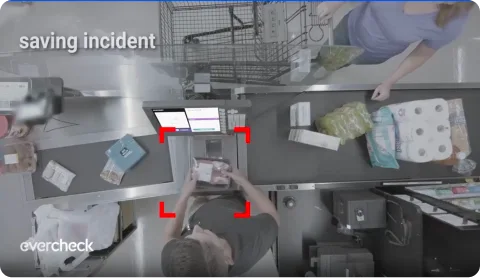
The value comes from catching loss in the form of missed scans, product switching, and abandoned transactions.
15% staff productivity improvement
Everseen’s checkout solution helped automate certain portions of loss prevention and customer interaction, cumulatively freeing up 15% of staff time previously spent managing self-checkout. These hours can be moved to helping customers on the shop floor and adding to the overall shopping experience in other ways.
A GM of omnichannel at a European retail franchise explained, "We now have a better understanding of the number of associates required at self-checkout. We've been able to task 15% of those workers with other more productive uses of their time."
Technology savings: $1,500 per store per year
Before deployment, some retailers used video tools that analyzed loss after it happened. These could inform future training, but they can’t stop loss in the moment. Everseen's solution replaced them, saving around $1,500 per store each year.
Retailers can also remove weigh scales from self-checkout for further savings. The study did not count this, as the composite retailer kept its scales in place.
Other important retailer returns
- A smoother checkout: Fewer false alerts mean fewer interruptions and shorter waits for everyone in the queue. When a correction is needed, a short repl/ay shows the shopper what happened. ECR Retail Loss data shows that shoppers self-correct after a soft nudge in 80% to 97% of cases.
- A clearer view of actual loss: Retailers gained a more accurate picture of what was happening at the checkout, including the share of loss caused by honest mistakes.
- Confidence to expand self-checkout: With loss under control and the customer experience protected, some retailers felt able to grow their self-checkout estates again.
Cost breakdown for these ROI numbers
Computer Vision AI deployment costs largely fall into three categories: ongoing fees, a one-off implementation cost, and staff training time.
Specific cost will vary across estates based on variables covered in “What affects your estate’s ROI” below. The proportions below give an example of how the investment cost is spread.
In the study, fees were the largest and main recurring cost. They covered the checkout solution and the accompanying analytics platform that helps retailers make sense of loss patterns across the estate and track ROI over time.
Implementation costs cover hardware such as servers, cameras (in cases where they are needed), and the internal and external labor to install and configure. This will depend on the existing estate.
Training is measured in staff time, about an hour and a quarter per person, including new starters. Even with the 61% annual turnover assumed in the study, training came to under 2% of total costs.
What affects your estate's ROI?
The retailers in the study recovered between $41,000 and $260,000 per store each year. The difference comes down to several factors, and these will affect your estate's returns as well.
- Current shrink levels: The solution recovers a share of the loss already happening at the checkout, so stores with more checkout loss have more value to recover.
- Store size and format: The composite retailer in the study runs large-format grocery stores. Smaller formats, with less revenue passing through the checkout, will see lower dollar figures per store.
- Average item price: In stores with higher-priced items, each recovered item is worth more.
- Checkout coverage: The more transactions that pass through covered lanes, the more revenue is protected and loss recovered.
- Detection sensitivity: A stronger setting recovers more value, with potentially more frequent checkout interruptions. Retailers choose their own balance, and the retailers in the study leaned toward protecting the customer experience. As one director of business enablement at a multinational retailer put it: "If we set [Everseen's solution] at full power and implemented additional team trainings, we would be extracting 20% to 30% more value."
- Existing technology: Hardware already in place lowers implementation costs, and older tools that can be retired add savings.
- Estate size and staffing: The number of lanes and stores determines fees and implementation costs. Staff numbers and pay rates also play into the productivity gains and training time.
Forrester’s study identified 0.14% of revenue passing through SCO recovered. ECR Retail Loss identified 0.13%; these serve as a great starting point for the recoverable value in your state.
Contact our team for a full cost estimate of rolling out checkout loss protection across your estate.
Other use cases for computer vision AI in retail
The figures in this guide cover the checkout loss prevention use case of Vision AI. But Everseen’s offerings are much broader, as retailers can extend deployment across the store and the store's wider operations.
Store Intelligence
Store Intelligence helps retailers understand how shoppers move through the store, how they interact with products, the condition of inventory, and other activity on the shop floor.
This wider view helps spot conditions that may contribute to loss before it reaches the checkout. It can also flag perishable stock nearing expiry and safety risks like spills or blockages.
Read more: The guide to store-wide retail business intelligence
Data Intelligence
Data Intelligence brings all the signals together, connecting what is happening at the checkout with the wider store. It is designed to explain why things are changing, as well as what has changed. Through a conversational AI interface, teams can ask questions in plain language and get answers grounded in data from across the platform.
Putting the numbers together
When weighing Vision AI deployments in real estate, checkout monitoring represents the biggest opportunity for businesses. Stores with self-checkout see 33% higher losses, and deploying vision AI here helps tackle shrink at the source.
Below is a recap of key numbers from a forester study showing what ROIs large-format retailers have seen in the past.
For the full methodology, read the Forrester Total Economic Impact study. To see how these figures could apply to your estate, talk to the Everseen team.
Frequently asked questions
The study was commissioned by Everseen and carried out by Forrester Consulting. Forrester kept editorial control over the findings and does not accept changes that contradict them or obscure their meaning. Everseen provided the customer names for the interviews but did not take part in the interviews themselves.
These results are from a study that modeled a large regional grocery retailer and represent what’s typical for similar-sized operations. Smaller formats will likely see lower dollar values per store. The greater value lies in using percentage figures, like 0.14% of covered revenue, as a starting point for calculating potential ROI.
In the study, the up-front investment paid for itself in under six months. Value recovered is spread out per checkout lane, and it adds up as transactions are processed.
Subscribe to the blog
Subscribe to Everseen's blog to receive emails about new posts and resources.


.jpg)