How retailers stop the banana trick at self-checkout
Learn how the banana trick works, why it causes self-checkout loss, and four ways retailers can spot and stop it before it eats into revenue.
Written by
Everseen
Read time
10 min
Published on
Nov 27, 2026

Self-checkout gives shoppers speed and control, and it frees store teams to focus on other work. But it also creates loss patterns that are largely absent at staffed checkout, with stores seeing a 22% increase in the first year of self-checkout rollout. Some of the biggest examples of these losses are skip-scanning, cart-based loss, and, of course, the banana trick.
What is the banana trick?
The “banana trick” is a self-checkout loss pattern where shoppers weigh a more expensive item but enter the code for a cheaper one, like bananas. The shopper pays the lower price even though they are walking away with a more expensive product, which creates loss for the store.
It is similar to other self-checkout patterns like ticket switching, where a cheaper item’s barcode is scanned in place of the real product. The difference is that the banana trick doesn’t involve a barcode. Instead, it relies on the produce code entered or selected at the terminal.
Why the banana trick leads to loss at self-checkout
The banana trick leverages the reduced supervision of self-checkout, since attendants can’t watch every single checkout terminal simultaneously. Besides reduced supervision, here are other reasons why the banana trick contributes to lost revenue:
- Some produce can’t carry barcodes: Loose items like bananas and other produce have nothing to scan, so shoppers have to search by name or type in a PLU code themselves. That puts the shopper in charge of identifying the product, and the standard self-checkout terminal has no way to double-check the choice.
- Scales can’t identify specific products: Self-checkout scales can be set to tolerate small differences, since constant “unexpected item in bagging area” alerts frustrate shoppers and slow down lines. The trade-off is that a scale can only confirm that something with weight is in the bag, not what that item actually is.
- Receipts are issued: From a sales perspective, nothing is obviously wrong. The sale went through, and unless security personnel at the exit checks every receipt item individually, nothing appears out of place. The discrepancy only shows up later during inventory audits.
- The price gap is big enough to tempt opportunistic shoplifters: Organic and specialty produce can cost more per pound than bananas. The gap on a single basket may look small, but across thousands of transactions it becomes a meaningful loss for retailers
Read more: Guide to self-checkout loss prevention for retailers
How do retailers tackle the banana trick?
Retailers use a wide range of loss prevention strategies to tackle the banana trick. Here are four approaches.
1. Reviewing transactions to find the store’s “banana”
Teams can start by comparing items sold at self-checkout vs. items that actually leave the shelf. With the banana trick, two product mismatches often appear together:
- A cheap item where more units have been sold than the stock count says is gone. This is the "banana."
- An expensive item that’s missing in stock, even though sales records indicate few or no sales account for it.
Random audits of self-checkout transactions can also help here. They keep records accurate and can make subtle patterns like this one easier to see.
2. Changing how the item is sold
It’s not always practical to change how frequently swapped items are sold. Loose items like bananas and grapes are sold loose so shoppers can choose their own quantity instead of picking up a prepackaged bunch.
But for some non-produce items, a useful strategy is switching them to a barcode, pre-weighed, or pre-packaged format. That removes the need for shoppers to choose the code and the ability to switch the item.
3. Adjusting supervision by transaction and time
Some retailers increase lane supervision during the hours when self-checkout loss is highest, for example by reducing the number of lanes a single attendant covers. Staff training can also help attendants spot when confused shoppers need assistance and step in to help them. This is important because not every mismatch is deliberate.
4. Receipt checks
Receipt checks are a traditional way to catch the banana trick. When staff have been briefed on the pattern beforehand, they know what to look for, and the check itself can act as a deterrent.
The trade-off is that receipt checks are voluntary, since customers can decline. A request to see the receipt can also create friction between customer and staff, particularly when the mismatch turns out to be an honest mistake.
How Everseen helps retailers tackle the banana trick
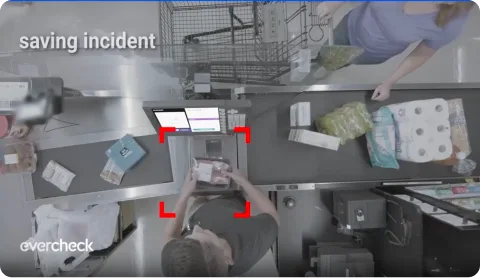
Everseen’s Checkout Intelligence helps retailers recover revenue at self-checkout by using Vision AI to analyze transactions in real time and flag discrepancies as they occur. It detects over 30 loss patterns, including product switching, where the item being purchased does not match the item rung up.
When it spots a mismatch, a soft nudge appears on screen before the shopper completes payment. It prompts them to check the item and includes an instant replay that helps identify exactly which one. Soft nudges clear over 80% of non-scan events, and associates are alerted separately only when support is genuinely needed.
Shoppers also get help identifying products faster, so there are fewer mistakes when selecting a code. Checkout Intelligence identifies bagged produce instantly, and shoppers can one-click confirm to proceed.
Every instance of loss identified and resolved is also accessible from a dashboard so teams can see how patterns connect across the store and even the wider estate.
Everseen is trusted by 11 of the world’s top 20 grocery retailers. Contact the Everseen team to find out how Checkout Intelligence can help your teams stop the banana trick and other self-checkout loss patterns.
Subscribe to the blog
Subscribe to Everseen's blog to receive emails about new posts and resources.