8 strategies to prevent self-checkout theft
Food retailers lose over $10 billion annually to self-checkout theft. Here's how leading retailers are tackling the problem.
Written by
Everseen
Read time
10 min
Published on
Nov 27, 2026

The introduction of self-checkout massively changed retail operations. It has lowered labor costs, increased store throughput, and generally improved the shopper experience.
Unfortunately, it has also introduced a new theft problem, increasing shrinkage by 22% in the first year for stores that just rolled out SCO.
Retailers use several tools to tackle internal loss in stores, and many of them transfer over to preventing SCO theft. In this post, we’ll cover the most widely adopted ones, including where they excel and their downsides. We’ll also share figures on the most effective strategies for reducing theft at self-checkout.
How big is the theft problem in self-checkout?
In a global ECR Retail Loss survey with 93 respondents, SCO was estimated to account for over 20% of total losses. Two-thirds of the participants claim that the problem is getting worse. And the underlying driver of this spike in loss is a lack of supervision.
Self-checkout integration in a store means fewer eyes tracking each transaction, and that creates room for both honest mistakes and deliberate loss. In the same survey, retailers estimated malicious behavior accounted for about 43% of losses at fixed self-checkout, while Scan and Go and mobile SCOs were estimated to be well over 50%.
In terms of overall losses:
- Food retailers are estimated to lose over $10 billion in profits annually to self-checkout.
- The California retailers report attributes $900 million in annual losses to self-checkout lanes.
- Various self-checkout incidents are also associated with losses. Missed scans average €2.50 ($2.81) per incident, items left in the trolley average €8 (~$9), and walkaways average €88 (~$100). (ECR Loss)
Retail margins are already razor-thin, so even small leaks add up quickly. Let’s look at strategies retailers are using to reduce these losses at self-checkout.
Top strategies for preventing theft in self-checkout
Uniformed security officers
Uniformed guards have always been a presence at many retail outfits, even before SCO rolled out. They provide physical deterrence and increase the perceived risk of theft.
With self-checkout, they play a similar role as the final point of intervention before a loss event is complete and the customers leave the store.
Unfortunately, uniformed security officers aren’t a perfect solution. They can’t observe every lane simultaneously, and given how customers interact with self-checkout, they can miss multiple instances of non-scans or product switching.
CCTV
CCTV cameras are the backbone of most modern loss-prevention systems, especially in retail. They are more cost-efficient than many solutions and, when used in combination with other methods of deterrence, can increase perceived risk for opportunistic shoppers. More importantly, they give teams increased visibility into what’s happening around the store.
The drawback of these is that they can only record and provide footage for review; they can’t detect or prevent loss in real time, unless integrated into a retail video analytics solution.
Receipt checks at exits
Receipt checks help teams spot and correct loss from both honest mistakes and intentional theft before the shopper leaves the store.
The drawback is that they are intrusive and risk creating confrontations and unnecessary customer friction, especially when a genuine misunderstanding has occurred.
Additionally, because receipt checks are voluntary, they don’t guarantee loss prevention, as customers can simply refuse.
Lock cases or defensive merchandising
Defensive merchandising is one of the oldest shoplifting prevention strategies, and it aims to prevent theft and loss even before the shopper ever reaches the SCO counter.
Here, interested shoppers will have to talk to the staff directly to access high-risk items like cosmetics, everyday essentials, and electronic accessories. Limiting access like this makes it harder for unintended mistakes and losses to happen without the staff’s knowledge.
But on the flip side, lock cases can also create friction and reduce overall sales.
Limiting items that can be processed at self-checkouts
Big retailers use item limits at self-checkout lanes to improve transaction speeds and customer experience while keeping loss exposure per transaction low.
Target, for example, has a 10-item limit and often closes and opens their express self-checkout lanes depending on the traffic they see every day. Meanwhile, Dollar General restricts self-checkout to 5 items or fewer.
But limiting SCO items is not perfect, and loss patterns like missed scans and product switching can still occur, regardless of how many items are in the basket.
Tagging high-value items with RFID tags
RFID tags use radio waves to identify products automatically. Instead of requiring each item to be individually scanned, an RFID reader registers everything in the checkout zone at once, reducing the possibility of missed scans. The tags can also integrate with an exit gate system, and that triggers an alert if an unpaid item leaves the store.
Big brands like Macy's, Nordstrom, Inditex, M&S, Nike, and Burberry use it. Burberry, in particular, credits the technology for reducing shrink.
Unfortunately, RFID tags can be costly to implement. Their use is often limited to apparel or high-value electronics rather than high-volume grocery environments. Liquids and metals can also interfere with the signal, making them unreliable for certain product categories.
POS exception reporting
POS exception reporting is a software-focused loss-prevention solution that flags register transactions from self-checkout stations when they deviate from normal patterns. This covers voids, discounts applied with no matching coupons, refunds, weight discrepancies, and other loss patterns.
The flagged transactions are then recommended for investigation, and mistakes are usually corrected by a staff member.
While powerful, POS exception reporting can be imprecise. They use raw register logs and can overshoot by generating lots of false positives or missing real cases of loss.
Vision AI and Everseen
Every strategy we’ve covered so far has been either preventative or sluggish and reactionary. They suggest solutions after the loss event has happened.
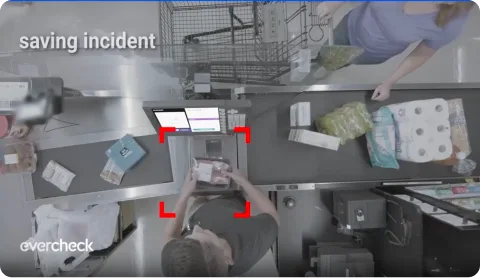
But Everseen’s Checkout Intelligence is able to detect loss events in real time before the customer leaves the till. It works by combining transaction data with live CCTV analysis, and when a loss event is detected, it displays a soft nudge notification on the screen. This allows the shopper to self-correct without staff intervention or confrontation.
Everseen’s solution can pick up on 30+ unique loss patterns, including abandoned transactions, items left in baskets, product switching, and non-scans.
In stores where Everseen’s solution is deployed, loss event rates are reduced by 25%.
Effective theft and loss prevention for retailers
Self-checkout implementation is associated with increased losses, but it doesn't have to stay that way. According to an independent study from Forrester, Everseen delivers 374% ROI over three years. And on average, stores that implement Everseen's solution see $88,000 added to their bottom line annually.
We’ve established that reducing self-checkout theft and loss requires a combination of strategies. 11 of the top 20 grocery retailers worldwide already include Everseen as part of theirs.
Contact our team to see how Everseen can fit into your loss prevention approach.
Subscribe to the blog
Subscribe to Everseen's blog to receive emails about new posts and resources.