Retail security AI: How AI stops shrink and loss
Discover how retail security AI uses computer vision to detect and prevent shrink in real time, from the aisle to checkout
Written by
Everseen
Read time
10 min
Published on
Sep 22, 2026

Loss prevention technology and strategy have always evolved to keep pace with shrink. CCTV monitoring, EAS and RFID tags, receipt checks at exits, and other tools address a piece of the problem. But, they only catch loss after it’s already happened or attempt to deter it in the first place.
Despite these measures, shrink keeps climbing. US retail shrink cost businesses $112.1 billion in 2022, up from $93.9 billion the year before, while shoplifting incidents specifically have risen 93% since 2019.
Retail Security AI is a modern tool for loss prevention that is able to detect, deter, and reduce shrink and loss in real time, making it more effective than most other strategies retailers use. Businesses adopting this technology are already seeing a positive trend in shrink, with providers like Everseen delivering 374% ROI over three years, based on independent findings from Forrester.
In this guide, we’ll cover how retail security AI works, why it’s different from what’s come before, and how it helps retailers drive down shrink.
What is retail security AI?
Retail security AI refers to AI-powered systems that detect, deter, and reduce shrink and loss in real time, using computer vision. It is built on Vision AI, a specialized application of computer vision focused on identifying and preventing retail loss.
Read about retail video analytics for insight into the other ways AI is used for loss prevention in the retail environment.
Why retailers are turning to AI for loss prevention
Traditional tools like CCTV, security tags, and guards have long been the backbone of loss prevention, but they can’t keep up with the modern retail environment. Grocery retailers are serving more shoppers than ever before, and the mass adoption of self-checkout has driven global shrink rates up.
According to an ECR Retail Loss report, shrink increases an average of 22% in the first year after SCO adoption. Traditional methods have no easy answers to these problems, because retail shrink is usually discovered after the fact.
- Guards can’t watch every aisle every second of the workday
- CCTV cameras are primarily forensic tools and deterrents, not preventative ones
- EAS and RFID tags typically only trigger an alert at the exit gate, and only if the tag hasn't been deactivated or removed.
They can’t stop shrinkage in real time. But retail security AI can. It watches every lane at once, recognizes loss patterns as they happen, and flags issues before a shopper reaches the door.
How does retail security AI work
Retail security AI processes visual data already captured via CCTV in most stores and analyzes it using machine learning models trained to recognize shopper behavior consistent with loss. These include:
- Non-scans at checkout
- Product switching
- Abandoned transactions
- Concealment
- And many more
All of this processing happens in real-time, at the edge, meaning suspicious behavior can be flagged and addressed before the transaction closes.
The value of this approach scales with the amount of real-world data behind it. The more transactions a model sees, the sharper its pattern recognition becomes.
Everseen, the incumbent in retail Vision AI, analyzes over 15 million retail transactions and processes more than 6 petabytes of behavioral data every day, with detection models that keep improving with every new iteration.
All that real-world data means the system is able to accurately differentiate between an honest shopper mistake and a genuine loss event.
How retail security AI reduces loss across the store
The biggest advantage of retail AI is coverage. It extends coverage across the store, with a focus on areas where loss occurs.
In the aisle
External theft accounts for more than a third of all retail shrink, and it starts in the aisles; by the time a shopper reaches checkout, the chance to catch it has typically passed. Vision AI addresses this by monitoring for behavioral patterns that correlate with loss in high-value shelf areas.
When a pattern crosses that threshold, a simple in-aisle audio alert lets the shopper know the area is monitored, stopping the loss in the moment, without requiring staff to intervene directly.
Retail security AI can detect the following patterns in the aisles:
- Concealment: Items hidden on the person or in bags before reaching checkout.
- In-store consumption: Products consumed before payment
- High-risk behavioral signals: Excessive handling and multiple picks of the same products
- Return visits: Repeatedly returning to the same high-value aisle or shelf.
At the checkout
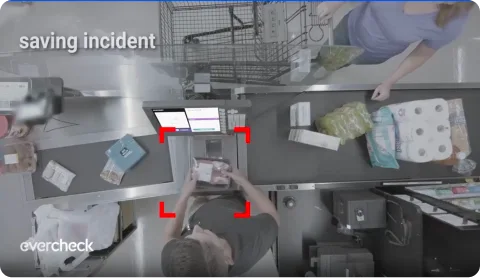
Checkout is where a significant share of retail loss becomes final, especially at self-checkout, where between 1 and 4.8% of all transactions involve a missed scan. Loss patterns are prevalent in staffed checkout too, with occurrences like sweethearting and discount abuse costing retailers.
Here, retail security AI takes the pressure off loss prevention teams by monitoring checkout aisles for patterns consistent with loss. Some of the patterns identified include:
- Scan avoidance and non-scan events
- Product switching
- Walk-offs and abandoned transactions
- Items left in baskets or under carts
- Sweethearting
When these patterns are identified in self-checkout, a simple Soft Nudge is displayed on the screen, informing the customer of the error and allowing them to self-correct without staff intervention.
In the queue
Not all lost revenue comes from theft. Long queues and short-staffed lanes can cause shoppers to abandon a purchase before they ever reach the register. This is a different kind of loss but still contributes to overall numbers.
Retail security AI extends to how the store runs day-to-day: how many shoppers are waiting, how fast lanes are moving, and whether staffing keeps pace with demand.
Here's how it works in practice:
- Queue prediction and lane optimization: Signals when more lanes need to open, based on real-time patterns, before wait times start driving shoppers away
- Staff coverage visibility: Hows where a checkout area is running short-staffed, so managers can act before it becomes a bottleneck
Across the store
Loss and inefficiency don't stop at the aisle or checkout. It shows up everywhere in the store, even if it’s not immediately obvious to LP teams.
Retail AI adds a new layer of visibility that runs through every part of the store, connecting what happens at the checkout to events in the aisles, the exits, and everywhere else that’s monitored. That way, teams can spot patterns that might’ve otherwise never emerged.
Retail security AI is the future of loss prevention
Shrink hasn't gotten simpler, but loss prevention has gotten more sophisticated. Retail security AI catches loss in real time and intervenes unobtrusively. It gives retailers a powerful tool for closing the shrink gap by watching for loss at every point, from the aisle to the checkout to the queue and everywhere in between.
Everseen has spent over a decade building retail AI solutions at scale and is trusted by 11 of the world’s top 20 grocery retailers.
Contact our team to see how Everseen’s Retail AI solution can work in your store.
Subscribe to the blog
Subscribe to Everseen's blog to receive emails about new posts and resources.


.jpg)